

Running a growing business often means spending a lot of time in meetings without seeing consistent follow-through.
Many leadership teams meet frequently but still struggle with execution, accountability, and recurring issues.
EOS meetings solve that problem. In particular, the Level 10 Meeting provides a simple, disciplined structure that helps leadership teams stay aligned and move the business forward every week.
What Is a Level 10 Meeting?
A Level 10 Meeting is a structured, weekly meeting in EOS that helps leadership teams stay aligned, accountable, and focused on execution.
It’s the primary weekly discipline used to strengthen the Traction component of EOS.
Unlike most meetings, which drift into status updates or open discussion, a Level 10 Meeting follows a consistent agenda designed to surface issues, make decisions, and move the business forward every single week.
The goal is simple: create a meeting that consistently drives execution, not just conversation.
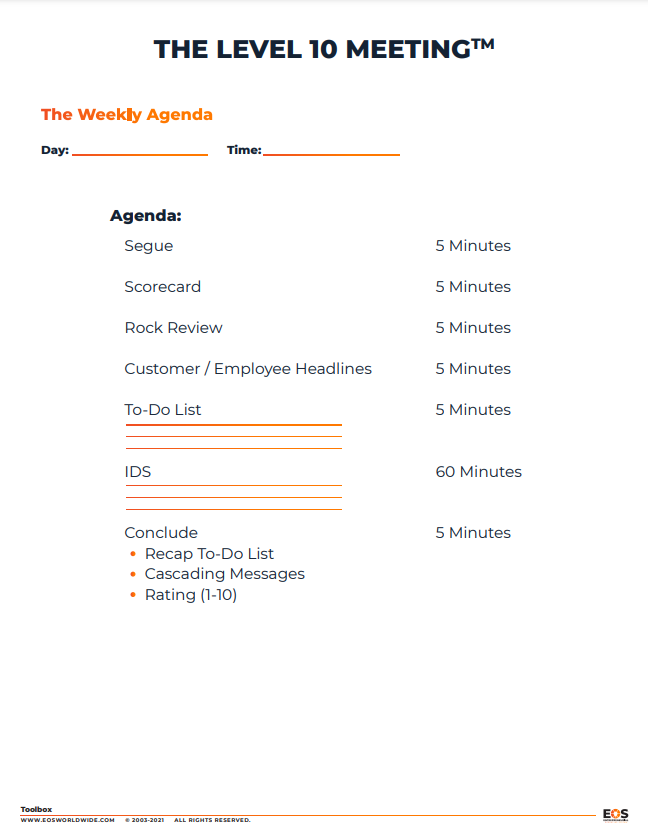
Download the agenda and follow along as you learn how to run an effective Level 10 Meeting.
Why Most Meetings Do Not Drive Execution
Many leadership teams spend hours in meetings and still feel behind.
Common problems include:
- Too much reporting and not enough problem-solving
- The same issues show up week after week
- Decisions lack follow-through
- Meetings run long without clear outcomes
When meetings lack structure and discipline, execution suffers. Leaders leave with more questions than answers, and teams default to reacting instead of executing.
The Level 10 Meeting fixes this problem.
How EOS Meetings Work
EOS meetings, a.k.a. the Level 10 Meeting, work because they’re built around a repeatable rhythm, clear ownership, and a shared commitment to solving the right issues.
Every Level 10 Meeting follows the same agenda, in the same order, every week. That consistency creates focus, accountability, and trust over time.
At a high level, the meeting includes:
- Reviewing weekly Measurables on the Scorecard
- Reviewing quarterly Rocks
- Reviewing last week’s To-Dos
- Identifying issues early
- Solving the most important issues at the root using IDS (Identify, Discuss, Solve)
Instead of discussing everything, the team focuses on what matters most right now.
The Level 10 Meeting Agenda Explained
While the exact timing may vary slightly by team, the structure always stays the same. That is intentional.
1) Segue and Scorecard
The meeting starts on time with a brief segue, followed by a review of the Scorecard.
Each Measurable has an owner and a weekly goal. Measurables are either on track or off track. There are no lengthy explanations.
If a number is off track, you add it to the Issues List.
This keeps the meeting grounded in data instead of opinions.
2) Rock Review
Next, the team reviews its quarterly priorities, called Rocks.
Each Rock is either on track or off track. If a Rock is off track, it becomes an Issue to solve.
This keeps long-term priorities visible and prevents them from getting lost in daily fire drills.
3) To-Do Review
The team then reviews last week’s To-Dos.
Each To-Do is either done or not done. There is no partial credit.
This step reinforces accountability and builds trust within the leadership team.
4) IDS: Identify, Discuss, Solve
IDS is the heart of the Level 10 Meeting.
The team selects the most important issues from the Issues List and works through them one at a time:
- Identify the real issue
- Discuss it openly and honestly
- Solve it with a clear decision or a new To-Do
By solving issues at the root, teams stop carrying the same problems from meeting to meeting.
5) Conclude
The meeting ends by:
- Reviewing new To-Dos
- Rating the meeting on a scale of 1 to 10
- Confirming next steps
The rating reinforces continuous improvement and keeps the meeting effective over time.
Why Are Level 10 Meetings So Effective?
Level 10 Meetings work because they change how leadership teams operate.
They are effective because:
- Issues get surfaced early instead of festering
- Decisions are made and followed through
- Accountability is built into the system
- Meetings stay focused and efficient
- Execution becomes consistent week after week
Over time, leadership teams spend less energy reacting and more energy executing.
What Makes Level 10 Meetings Different From Regular Meetings?
Most meetings focus on sharing information, whereas the Level 10 Meetings focus on solving problems.
Key differences include:
- A fixed agenda instead of an open discussion
- A weekly cadence instead of ad hoc scheduling
- Data-driven review instead of anecdotal updates
- Clear ownership and follow-through
This structure removes ambiguity and creates momentum.
Related Reading: What Does a Perfect Level 10 Meeting Look Like
Who Runs Level 10 Meetings?
Level 10 Meetings are run by the leadership team, with one clear owner.
Typically, the Integrator owns and facilitates the meeting, keeping the team on the agenda and moving forward. The Visionary participates but does not run the meeting.
Level 10 Meetings won’t replace all meetings in the organization. They provide a weekly execution rhythm at the leadership team level.
Many organizations later adapt the same principles for other teams, but the core Level 10 Meeting remains a leadership team discipline.
How Level 10 Meetings Support Accountability Without Micromanaging
One of the most significant benefits of Level 10 Meetings is that they reduce the need for micromanagement.
Because Rocks, numbers, and To-Dos are reviewed every week:
- Leaders do not have to chase updates
- Issues surface naturally through data
- Accountability is created by the system, not personalities
The system holds the team accountable, so leaders do not have to do it individually.
How Level 10 Meetings Fit Into EOS
The Level 10 Meeting does not stand alone.
It works alongside other EOS Tools, including:
- The Accountability Chart, which defines ownership
- The Scorecard, which tracks weekly performance
- IDS, which solves issues at the root
Together, these tools strengthen Traction and create a complete operating rhythm for execution.
If you want to see how these tools work together, EOS Academy is a free way to explore EOS in more depth. Enroll for free and start exploring EOS Academy today.
FAQs
What is a Level 10 Meeting?
A Level 10 Meeting is a weekly, structured meeting in EOS that helps leadership teams stay aligned, solve issues, and execute consistently.
How do EOS meetings work?
EOS meetings follow a consistent agenda that includes reviewing weekly Measurables, Rocks, and To-Dos, then solving the most important issues using IDS.
Why are Level 10 Meetings effective?
They create a repeatable rhythm for accountability, focus, and issue solving, which leads to stronger execution over time.
Bringing Level 10 Meetings Into Practice
For many leadership teams, the Level 10 Meeting is where EOS starts to feel real.
When meetings become disciplined, focused, and action-oriented, execution improves quickly.
Some companies choose to work with an EOS Implementer to help install the Level 10 Meeting correctly, ensure it’s run with discipline, and integrate it with the rest of the EOS Tools. To get started, schedule a 90-Minute Meeting with our team. Our Client Advisors have helped thousands of leadership teams improve execution by getting their meetings right and finding the right EOS Implementer. During your call, we’ll learn more about your business, determine whether EOS is the right fit, and help you identify the best next step to get started.
Ready to Run Better Meetings?
An EOS Implementer can help your leadership team solve issues at the root, strengthen accountability, and gain real Traction.