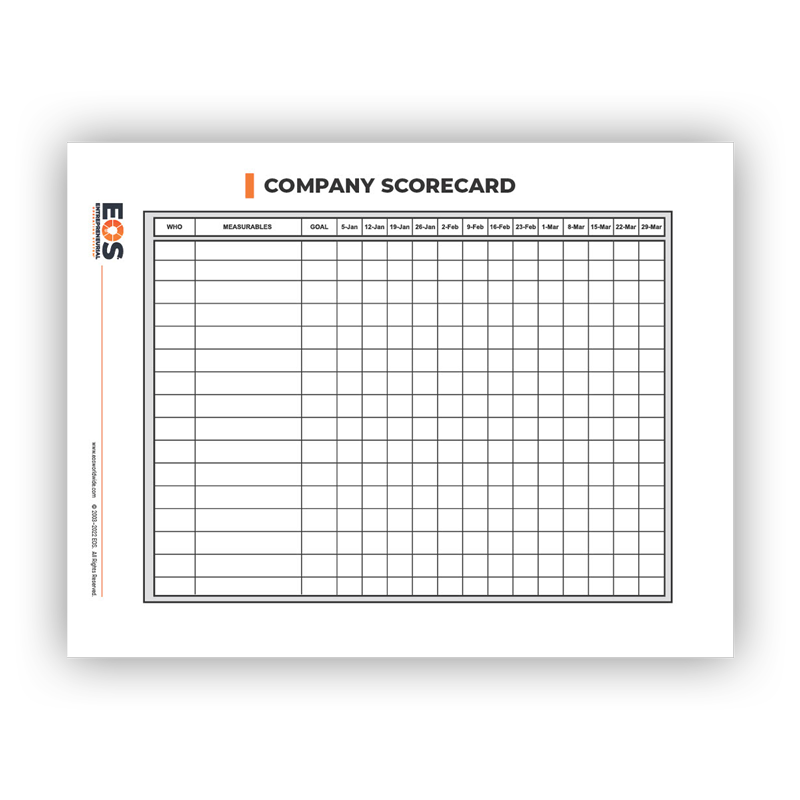
Leaders often wonder how they should use EOS® Scorecards and KPIs within their businesses.

I always tell my clients: Want a great Scorecard? Ask great questions! So I ask them to envision an exceptional week and what happened in each function to make it exceptional.
For example, a manufacturing leader thinking about operations might expect to hear direct reports provide examples like:
- Near-zero rework
- Extremely low wastage
- Minimal downtime on machine X
- The shrink-wrap machine didn’t get hung up like it usually does
- All shifts started on time
- No overtime work because of screwups
- Production schedule met to a T
Valuable Outcomes From Using a Scorecard
Examples like these should come pouring out of leaders’ heads because each is key to having a great week. And each can be measured, sometimes in a system and sometimes with just hash marks on a whiteboard.
Team leaders can establish goals for the week for each measured activity and track its progress. Plus, these weekly measurements will provide three valuable outcomes:
- The team will have a strong pulse on manufacturing performance. They can act quickly if something goes off track.
- Team members can better predict longer-term operational and financial performance.
- They will build a higher level of accountability among the people running the factory.
Build Your Scorecard Around Your Team
Rather than impose a Scorecard on a team, I help leaders blossom a collaborative one from the team’s aspirations. This approach produces a high level of ownership and works in any business function.
For example, a software company’s leadership team struggled to build a Scorecard for the developers in their firm. They asked, “Can this really work? Will you help us with this?”
We gathered 15 developers at the firm with an opening question: “Say you drive home from the office on a Friday afternoon with a huge smile on your face. You get home and tell your spouse as you walk through the door that you had the most fantastic, wonderful week. What would’ve happened that week to cause that reaction?”
I distinctly remember a few of their answers:
- “I didn’t get interrupted in the middle of a development loop to go to some useless meeting!”
- “I learned something new that will help me in my job and the future.”
- “The product team and I collaborated to figure out a tough solution. Now that solution can be replicated again and again to help our clients.”
Their boss sat quietly in the back of the room. I asked him, “Could you measure these as they walk out the door on Fridays? How would your business change if every week your developers had a ‘great week’ as described today?”
His answer was quick and positive: “We would be amazingly better than we are today!”
Finally, I suggested the business leader start measuring those things that made a difference for his sharp software development team. That makes sense, right?
So, have a great week, and measure what made it so!
Previously published on the Clear Horizon Leadership blog.