

A reactive business runs you when most of your time goes toward handling whatever needs attention right now instead of making progress on the work that would make the business easier to run.
You may start the week knowing exactly what matters most, only to reach Friday with those priorities barely touched. You worked hard and solved real problems, but most of your time went to keeping things moving instead of making the business stronger.
That happens once in a while in any company. The bigger problem is when it becomes the normal way you operate. Important work keeps getting pushed aside, the same problems keep taking up your time, and you stay involved in decisions you thought your team would eventually be able to handle without you.
If your business feels out of control or you can’t seem to step away from it, you may be stuck in a reactive cycle.
What Is a Reactive Business?
A reactive business is one where immediate needs regularly take priority over the work you’ve already decided matters most.
You may have clear goals and priorities, and your leadership team may agree on what needs to change. The problem is that once the week gets busy, the work you said mattered most is often the first thing to get pushed aside.
You can see this most clearly in the problems that keep coming back.
Suppose you know a process is creating unnecessary work for your team. Fixing it would save time and prevent problems, but doing that takes focused attention. Meanwhile, the problems caused by that process need answers today.
So you deal with what’s in front of you and tell yourself you’ll come back to the bigger fix later. There’s nothing wrong with making that call once in a while. The reactive cycle starts when “later” never really comes.
The process keeps creating problems, those problems keep demanding attention, and the work that could break the cycle keeps getting postponed.
When that keeps happening, the business gets very good at responding to problems but not much better at preventing the same ones from recurring. That’s what can make a reactive business so frustrating. Everyone may be working hard and getting a lot done, but the company still isn’t making steady progress on the work that would make it easier to run.
Why Does a Reactive Business Start to Feel Out of Control?
As more of that important work gets pushed aside, more of the day-to-day decisions and problems tend to stay with the owner.
When the company is small, that can work for a while because you’re close to everything. You know what matters, your team can ask you when they aren’t sure, and you can change direction quickly because you still have a clear picture of the whole business.
That gets much harder as the company grows.
As you add people and responsibilities, more decisions have to be made without you in the room. Your leaders have to decide what deserves attention when several things matter at once. And if the clearest picture of where the company is going still lives mostly in your head, those decisions naturally keep coming back to you.
That doesn’t necessarily mean you haven’t delegated enough. You may have capable leaders who take ownership of their work. Delegation only goes so far, though, if they still have to come back to you whenever priorities compete.
When something urgent conflicts with something important, your leaders need enough clarity to know what matters most.
How Do You Stop Reacting and Start Leading?
The goal isn’t simply to get more decisions off your plate. It’s to give your team enough clarity to make good decisions without having to rely on you every time something changes.
That usually comes down to three things your leadership team needs to understand well enough to use in the day-to-day:
Where the business is going: Most owners have some picture of the company they want to build. For that picture to help your team, everyone needs to understand it well enough to use it in decision-making.
What matters most right now: A long-term direction won’t help much if everything still feels equally important this quarter. A few clear priorities help people know where their attention belongs and when something urgent truly requires changing the plan.
How you’ll stay focused: Problems will still come up, and priorities won’t always go according to plan. A regular meeting gives your leadership team a place to check progress, work through problems, and keep important work from getting lost in the week-to-week.
Put those three things together, and your team has something it can actually use when the week gets messy.
Instead of asking you to reset the direction every time something changes, your leaders know where the business is going, what matters most right now, and how to keep the important work moving.
How EOS Helps You Get Clear and Stay Focused
That’s the kind of clarity and focus EOS is designed to help leadership teams create.
EOS, the Entrepreneurial Operating System, is a complete, proven system that helps entrepreneurs get what they want from their businesses with simple, practical tools.
Get Clear on Where You’re Going
The Vision/Traction Organizer helps your leadership team answer eight questions and get 100% aligned on where your organization is going and how you plan to get there.
For an owner who feels pulled into everything, that matters because the direction of the business no longer has to live mostly in your head. Your leadership team has something clear and shared to work from.
Turn Vision Into Near-Term Priorities
Once everyone is clear on where you’re going, the next question is what needs to happen now.
The Vision/Traction Organizer connects that longer-term Vision to what needs to happen over the next year and the next 90 days. Your team identifies its most important priorities for the next 90 days, called Rocks, so everyone knows what needs to get done to move the business forward.
Stay Focused as the Business Changes
Setting priorities is one thing. Keeping them from getting buried when the week gets busy is another.
EOS supports that focus through a Meeting Pulse, a regular schedule of meetings that helps your team stay connected to its priorities and address the Issues getting in the way.
Together, the Vision/Traction Organizer and Meeting Pulse give your leadership team a clearer direction and a consistent way to stay focused on it. Instead of waiting for you to pull everyone back to what matters, your leaders have a structure that helps them keep moving without depending on you for every reset.
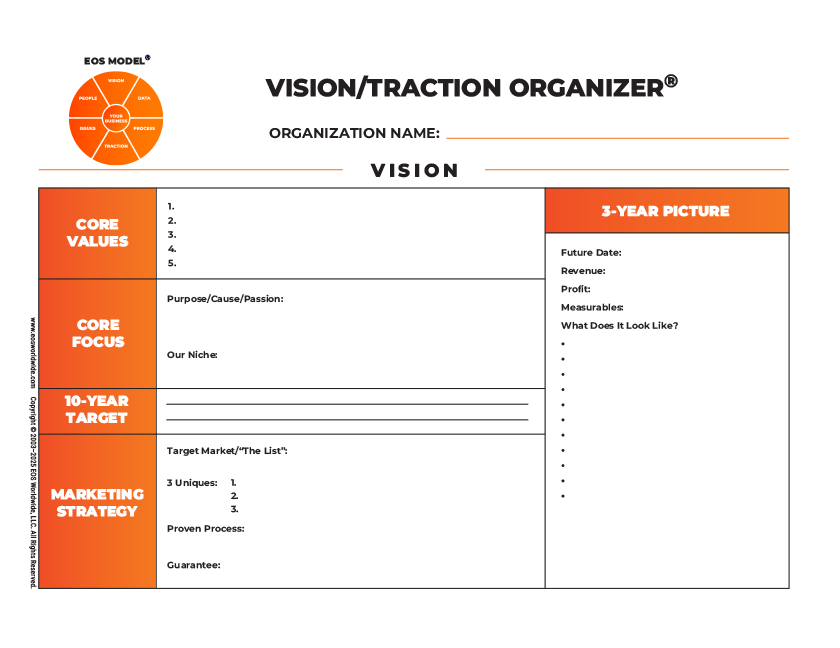
Turn scattered ideas into one clear vision your team can follow.
Start Taking Back Your Time
Running a less reactive business doesn’t mean the unexpected stops happening. It means those surprises stop having so much control over your week.
Getting out of reactive mode means getting better at deciding what deserves your attention, rather than letting whatever feels most urgent make that decision for you.
Start by looking at the important work that keeps getting pushed back. Then look at the problems and decisions that repeatedly push it aside.
If the same things keep coming back to you, ask yourself what your team would need in order to handle more of those situations without you. Sometimes the answer is handing something off or making ownership clearer. Other times, people simply need a better understanding of where the business is going and what matters most right now.
As that gets clearer, your team can make more decisions, solve more problems, and keep important work moving without waiting for you to weigh in every time.
That gives you more time to lead the business instead of spending your days reacting to it.
Get Your Leadership Team on the Same Page
If that sounds like what’s happening in your business, a good place to start is getting your leadership team on the same page.
The Vision/Traction Organizer can help you put your direction on paper and get your leadership team aligned around it.
Download the Vision/Traction Organizer to work through the eight questions that help leadership teams get 100% on the same page with where their organization is going and how they plan to get there.
If you want to learn how the Vision/Traction Organizer, Meeting Pulse, and other EOS Tools work together, schedule a free 90-Minute Meeting. You’ll get an introduction to EOS, the EOS Model, EOS Tools, and EOS Process, then decide whether EOS fits what your business needs.
Ready to implement EOS?
An EOS Implementer helps your team install the full system and execute it with confidence.
Frequently Asked Questions
What Is a Reactive Business?
A reactive business is one where immediate needs regularly take priority over the work the company has already decided matters most. That can leave the team busy solving today’s problems while the priorities and improvements that would make the business stronger keep getting pushed aside.
Why Does My Business Feel Out of Control?
Your business may feel out of control because too many priorities and decisions still depend on your guidance. As the company grows, your team needs to know where the business is going and what matters now so people can make more decisions without having to come back to you each time.
How Do I Stop Reacting and Start Leading My Business?
You stop reacting and start leading by making the company’s direction and current priorities clear enough for your team to use them in everyday decisions. From there, regular meetings help the team stay focused, work through problems, and keep priorities moving.
Why Am I Always Putting Out Fires at Work?
You may keep putting out fires because the immediate problem gets handled, but the underlying cause never really gets addressed. When the same problems keep coming back, it’s often a sign that something underneath the immediate issue still needs attention.
How Can I Step Back From My Business?
You can begin to step back when your team has enough clarity to make more decisions and keep priorities moving without waiting for you. Delegating work is part of that, but your leaders also need to understand the direction they should use to guide those decisions.