

A growing business needs a consistent business meeting rhythm to keep its leadership team connected, focused, and moving forward.
As your business grows, the quick conversations that once kept everyone connected become less reliable, especially as leaders take ownership of different parts of the company.
A consistent business meeting rhythm gives the team a dependable place to see what’s happening, make decisions, and keep important work moving. It also helps the team keep weekly work connected to the priorities they’ve set for the quarter and the direction of the business.
Growth Changes How Your Leadership Team Communicates
As responsibility spreads across a growing company, your leadership team needs a more intentional way to stay connected.
In the early days of a business, the people making key decisions are often close to the work and to one another, so they can solve a problem quickly or change direction without much coordination.
Growth makes that harder to sustain. A leader may understand their own part of the business well without seeing how a decision in one area could affect another part of the company. At the same time, the owner can’t keep filling in every communication gap without becoming a bottleneck.
That’s often when leadership teams feel the strain. A problem that touches several parts of the company can move slowly because no one has a dependable place to bring everyone together. Important context can stay with one or two people longer than it should, leaving others to make decisions with only part of the picture.
A regular leadership team meeting helps create that shared view. Everyone knows there’s time set aside to look across the business and work through decisions together.
And that set meeting becomes even more valuable when people trust it. Leaders know an important conversation has a place to happen, and they don’t have to rely as heavily on side conversations or the business owner to keep everyone connected.
A Business Meeting Rhythm Keeps the Team Connected
A consistent weekly meeting gives your leadership team a dependable place to keep important work visible and move decisions forward.
It also changes what happens between meetings. Leaders know what needs attention now, what can wait until the team is together, and when a previous decision will come back for review.
For the meeting to become something the team actually relies on, it needs to do a few things:
- Give leaders enough information to see what’s happening across the business
- Leave time to solve the problems that need the whole team
- Make it clear who owns the next step after a decision is made
- Give the team a way to check whether that decision actually worked
A weekly meeting can happen at the same time every Tuesday and still leave the team frustrated if most of the conversation is spent catching everyone up.
Imagine your company tracks how long it takes to onboard a new customer. When that number starts moving in the wrong direction, the team needs to see it. Once everyone understands there’s a problem, the conversation can move to what’s causing it and what needs to happen next.
That’s a much better use of leadership time than spending most of the meeting explaining everything that happened during the week.
Over time, those conversations build on one another. The meeting stops feeling like a weekly reset and becomes part of how the business actually runs.
A consistent meeting rhythm can take a lot of communication pressure off a growing company. It still needs one more thing, though: a connection to where the business is going.
Your Weekly Meetings Need a Longer View
Weekly leadership meetings are most useful when they do more than help the team deal with what happened this week. They also need to keep everyone connected to the priorities the team has set for the quarter and the direction of the business.
That matters because the urgent stuff will always compete for attention. Customer needs, day-to-day problems, and unexpected Issues can easily take over the conversation. Without a way to keep the bigger priorities in view, the work that matters over the next few months can get pushed aside.
Quarterly planning gives the leadership team time to step out of the day-to-day and decide what matters most for the next 90 days. A growing business will usually have more worthwhile opportunities than the team can pursue at once, so setting clear priorities helps everyone make better choices once the regular workweek starts again.
Annual planning gives the team a wider view. It creates time to think about where the company is headed and what needs to happen over the coming year to keep moving in that direction.
Those planning sessions matter more when the weekly meeting keeps the priorities in front of the team.
Suppose the team agrees during quarterly planning that improving customer onboarding is one of its most important priorities for the next 90 days. That priority shouldn’t disappear into a planning document until the quarter ends. The weekly meeting should make it easy to see whether the work is moving forward and whether anything is getting in the way.
That’s what keeps planning connected to the work happening every week.
Build a Meeting Rhythm Your Team Can Rely On
A strong business meeting rhythm is simple enough to use consistently and clear enough for your leadership team to know what each meeting needs to accomplish.
Start with the weekly leadership meeting you already have. Protect a consistent time on the calendar and make sure people come prepared with the information the team needs.
Then build around it:
- Protect dedicated quarterly and annual planning time before the calendar fills up
- Keep the priorities set in those sessions visible once everyone gets back to work
- Make ownership clear when the team makes a decision
- Check future meetings to see whether the decision actually solved the problem
- Pay attention to what happens between meetings
That last point matters. If leaders still have to chase one another down to get decisions made, the regular meeting may not be giving the team enough room to solve the right problems. If priorities keep disappearing, the weekly meeting probably isn’t keeping them visible.
A meeting rhythm that works well should make the business easier to run as the company grows. Leaders know where to bring important conversations, the team can stay connected without involving the owner in everything, and longer-term priorities don’t disappear under the pressure of the week.
For leadership teams that want a proven system for running this way, EOS has a specific approach.
How EOS Puts a Business Meeting Rhythm Into Practice
EOS uses a structure called The Meeting Pulse to connect weekly leadership team meetings with quarterly and annual planning.
EOS, the Entrepreneurial Operating System, is a complete, proven system with simple, practical tools that help entrepreneurs get what they want from their businesses. So, leadership teams get on the same page about where the company is going, become more disciplined and accountable in executing that Vision, and work together as a healthier, more cohesive team.
The Meeting Pulse gives that work a consistent place to happen throughout the year.
During quarterly and annual planning, the leadership team uses the Vision/Traction Organizer to stay aligned on where the company is going and how it plans to get there. Every quarter, the team also sets Rocks, the most important priorities to complete over the next 90 days.
Those Rocks stay in view during the weekly Level 10 Meeting.
The Level 10 Meeting is a 90-minute team meeting held each week on the same day and at the same time, following the same agenda and starting and ending on time. Its structure helps the team understand how the business is doing without letting updates dominate the conversation.
The team reviews its Scorecard and weekly Measurables, checks the status of Rocks, shares important customer and employee headlines, and follows up on the previous week’s To-Dos. When something needs more attention, the team puts it on the Issues List and works through it during IDS: Identify, Discuss, and Solve.
Most of the Level 10 Meeting is reserved for IDS, which gives the team time to get to the root of an Issue and solve it. When that solution requires action, the team creates a To-Do and checks it the following week.
The weekly Level 10 Meeting keeps the leadership team close to what’s happening now, while quarterly and annual planning keep that work connected to the company’s Vision. Together, they create The Meeting Pulse that helps the team stay focused and gain traction as the business grows.
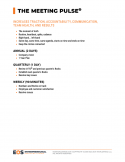
Create a meeting structure that keeps teams connected, accountable, and moving forward.
Bring More Structure to Your Weekly Leadership Meeting
If your leadership team already meets every week, the Level 10 Meeting Tool gives you a proven 90-minute agenda for making better use of that time. It can help your team see what needs attention and protect more of the meeting for solving Issues.
A 90-Minute Meeting can help you understand how The Meeting Pulse fits into the rest of EOS. Your leadership team can learn how the system works, ask questions, and decide whether it makes sense for your business.
Ready to implement EOS?
An EOS Implementer helps your team install the full system and execute it with confidence.
Frequently Asked Questions
Why Does My Business Need a Consistent Meeting Rhythm?
A growing business needs a consistent meeting rhythm because informal communication becomes less reliable as more people take on responsibility. Regular leadership meetings give the team a dependable place to stay connected and keep important work moving.
What Is a Meeting Pulse in Business?
The Meeting Pulse is the EOS structure that connects weekly leadership team meetings to quarterly and annual planning. It keeps weekly execution tied to the priorities and Vision the leadership team has established for the business.
What Is the Difference Between Meeting Rhythm, Meeting Cadence, and Meeting Pulse?
Meeting rhythm and meeting cadence are common ways to describe how recurring business meetings fit together over time. The Meeting Pulse is the EOS structure that connects weekly, quarterly, and annual meetings.
How Does EOS Structure Meetings?
EOS connects weekly, quarterly, and annual leadership team meetings through The Meeting Pulse. The weekly Level 10 Meeting keeps the team close to execution, while quarterly and annual planning give leaders dedicated time to stay aligned around the company’s Vision and priorities.