A Quarterly Conversation gives you and your direct report dedicated time every 90 days to talk about things that don’t always surface during the normal workweek. You should both leave knowing what’s going well, what needs attention, and what needs to happen next.
Quarterly Conversations are an important part of the EOS Meeting Pulse. But I’ve seen some leaders follow the format, cover the expected topics, and still walk away without getting much deeper than they would in a regular one-on-one.
You can bring up something that’s been lurking in the background, recognize progress that deserves more than a quick mention, or address a concern before another quarter passes.
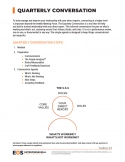
The framework is intentionally straightforward. Use the 5-5-5 as your guide, talking about What’s Working and What’s Not Working in the context of Core Values, Roles, and Rocks. The difference between a forgettable meeting and a strong one usually comes down to how you handle the conversation.
Here are 10 fresh ways to approach your Quarterly Conversations.
Make one-on-one feedback simpler, clearer, and more consistent.
1. It’s a Conversation, Not a Performance Review
Your direct report should be talking with you, not sitting through your evaluation of them. A Quarterly Conversation isn’t a performance review. It’s a two-way conversation about What’s Working, What’s Not Working, and anything that needs attention.
You’ll have feedback to give, and you should also ask questions and listen closely. The goal is to create enough space for your direct report to say what’s really going on, including things you may not have known before the conversation started.
If you’re doing most of the talking, you’re probably missing part of the value. A strong Quarterly Conversation gives both of you the chance to talk openly about the work, the relationship, and anything getting in the way.
2. Schedule It Well in Advance
Put every Quarterly Conversation on the calendar well in advance of the meeting date. Scheduling it ahead of time gives you both time to notice behaviors, accomplishments, results, and topics you want to discuss.
This is especially helpful when talking about Rocks. If a Rock isn’t going well, use the conversation to understand what’s getting in the way and whether there’s an Issue that needs to be addressed.
Scheduling these conversations in advance also reinforces that this time matters. Quarterly Conversations are part of the discipline of leading and managing your people, not something to fit in only when the quarter happens to be less busy.
3. Ask for Feedback on Yourself as a Leader
If you expect candor from your direct report, you must be willing to receive it too. Leaders spend plenty of time giving feedback, but the Quarterly Conversation should also give the other person room to talk about how you’re leading them.
Ask questions like, “What could I be doing differently to help you in this seat?” or “Is there anything I’m doing that’s making your job harder?” You may hear something you don’t love, and how you react will tell the person whether you really wanted the answer.
You don’t have to agree with every piece of feedback. You do need to listen with an open mind and understand where it’s coming from.
4. Go Offsite & Grab a Coffee
Sometimes the best way to have a different conversation is to get out of the room where you have all the usual ones. I like leaving the office when it makes sense, whether that means grabbing coffee, getting lunch, or having a drink at the end of the day.
The change of setting helps both people step out of task mode and talk more freely.
You don’t need to make a production out of it. A quieter table away from laptops, notifications, and the next meeting on the calendar can be enough.
5. Start with What’s Working
Give What’s Working the same attention you give What’s Not Working. Talk about wins from the quarter, progress the person is proud of, and moments when you noticed them do especially strong work.
Use specific examples. If they handled a difficult customer well, stepped up when the team was overloaded, or lived a Core Value in a way that helped someone else, say what you saw.
That gives the person a better sense of what you want them to keep doing, rather than leaving recognition as a vague “nice job.”
6. Agree on What Happens Next
‘We should work on that’ isn’t a solution. If the two of you agree that something needs to change, be clear on what happens next and who is accountable for it.
Maybe there’s a specific action the person needs to take. Maybe you agreed to make an introduction, remove an obstacle, or resolve something on your side. Make the commitment clear enough that both of you know what happens next.
You don’t need to turn every discussion into a mini project plan. But you do need to keep it from disappearing once the meeting ends.
7. Mind the Question-to-Statement Ratio
Pay attention to how much of the conversation consists of questions versus statements. If you already know everything you plan to say before the meeting starts, you’re not leaving much space to learn anything.
Follow-up questions usually get you farther than the first one. If someone says a Rock is Off Track, ask what’s behind it. If they say part of the job has been frustrating, ask them to explain. If you get an automatic “everything’s fine,” stay with it for another minute.
You’re not trying to interrogate them. You’re just giving the person time to move past the first answer.
8. Dig in Deep
Some of the most important topics show up softly at first. A person may mention a recurring frustration, uncertainty about part of the role, or tension with a teammate without presenting it as a major problem.
When you hear something that sounds unfinished, stay with it. Ask what’s driving it, how long it’s been happening, and what the person thinks would change the situation.
Quarterly Conversations give you a chance to address these things before they turn into bigger Issues. If the same concern keeps appearing quarter after quarter, that deserves attention.
9. Get Specific About Rocks
Don’t simply accept ‘On Track’ or ‘Off Track’ and move on.
Use the conversation to understand What’s Working and What’s Not Working with the person’s Rocks. Ask where they’re making progress, where they’re getting stuck, and whether an Issue needs to be addressed.
10. Really Talk About the Core Values
Core Values mean more when you can point to behavior than when someone can repeat the words from memory. Use the Quarterly Conversation to talk about where you’ve seen the person live them and where you’ve seen something different.
Examples help. Instead of saying someone is “a plus” on a Core Value, talk about the decision, customer interaction, or team moment that led you there. If there’s an area to address, be equally specific about what you observed.
You can also ask how the person sees the Core Values playing out around them. Their answer may tell you something about the team or company that you’re not seeing from your seat.
Make the Conversation Count
You can use the same Quarterly Conversation framework every 90 days without repeating the same conversation. Core Values, Roles, and Rocks give you the subjects to cover, but what you talk about should come from what’s happening with that person now.
Before each meeting, think about what you want to understand better. Consider where the person has made progress, where you’ve noticed difficulties, how they’re doing in their Roles, what their Rocks are showing you, and anything you’ve been meaning to discuss but haven’t.
Then let the conversation go somewhere you didn’t expect. One quarter could require direct, constructive feedback about something that’s not working. Another might reveal that someone is ready for more responsibility, needs different support from you, or has been waiting for a chance to raise an Issue.
You’re having the conversation every 90 days because people, roles, priorities, and working relationships change. Waiting a full year gives too much time for small problems to settle and for good work to go unrecognized.
If Quarterly Conversations like this are missing from your organization, there may be other EOS disciplines that could help your leadership team get more aligned, accountable, and focused.
A free 90-Minute Meeting gives your leadership team a chance to see how the EOS Process works. You’ll get a high-level look at the EOS Model and the tools used to strengthen the Six Key Components of your business, then decide whether implementing EOS is the right fit for your team.
Ready to implement EOS?
An EOS Implementer helps your team install the full system and execute it with confidence.