One of the fastest ways to expose a fuzzy Vision is to put a leadership team through this visualization exercise. In a few minutes, it changes how leaders think about the 3-Year Picture before they even start filling it out.
For companies new to the Entrepreneurial Operating System, the 3-Year Picture is one of the first opportunities to describe the business in concrete terms. It’s the fifth of the eight questions on the Vision/Traction Organizer, helping the leadership team paint a clear picture of what the organization will look like three years from now.
That sounds straightforward, but teams discover quickly that they’ve been using the same words while picturing very different outcomes. A phrase might feel perfectly clear when everyone is nodding around the table, yet each person can still attach a different meaning to it.
Before I start building the 3-Year Picture with a leadership team, I like to make that difference visible with a quick exercise. It involves a cat, a vase, a table, and a very short story.
Try This Before You Build Your 3-Year Picture
I ask everyone to humor me for a minute, lean back in their chairs, close their eyes, and picture the scene I’m about to describe.
I tell them they’re all in a conference room sitting around a table. On the table is a vase holding a bouquet of flowers, and next to it is a cat. Then the door swings open and someone bursts into the conference room, startling the cat, who then knocks over the vase and flowers before scurrying out of the room.
Then I ask everyone to open their eyes and start with the person sitting to my left. I ask them:
- What did the table look like?
- Was the vase glass or ceramic?
- What type of flowers were in the vase?
- What kind of cat did you picture?
- Did the vase break when it fell?
The answers vary almost immediately. Someone saw a brown wooden table, while someone else pictured glass. One person imagined roses while another saw daisies or tulips. The cat might’ve been a tabby, calico, tuxedo, or something else entirely.
Everyone heard the same description at the same time, yet each person supplied different details.
That’s the point I want the team to experience before we even touch the 3-Year Picture.
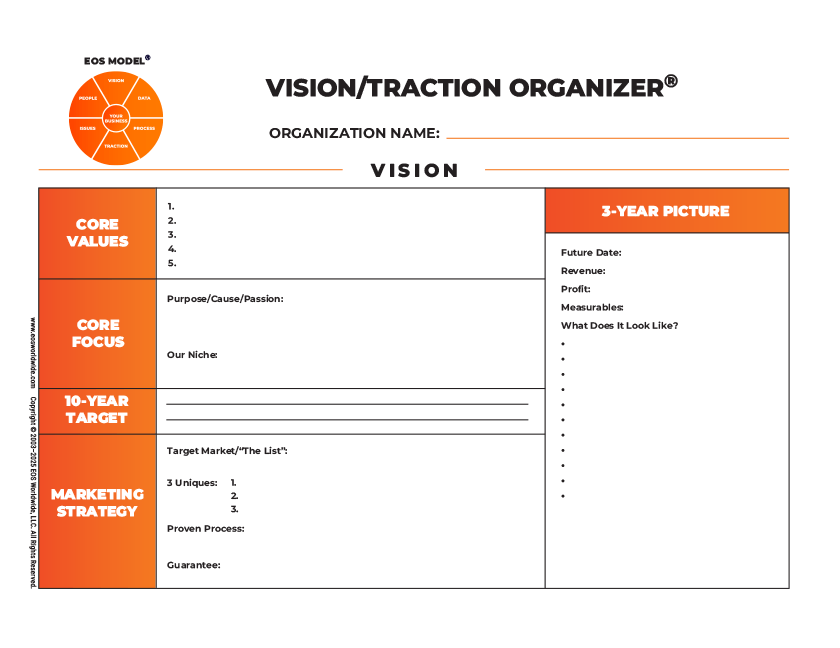
Turn scattered ideas into one clear vision your team can follow.
Agreement on the Words Doesn’t Mean Agreement on the Vision
Leadership teams can agree on the same sentence while holding very different ideas about what it means. You can see it quickly once a company starts putting its Vision into writing.
Imagine someone says that three years from now the company will have a “strong leadership team.” Everyone nods because the statement sounds right, but one person may picture five experienced leaders, each owning a major function. Someone else may see the current team operating with more responsibilities. Another person may assume the company will have added a COO, while someone else may interpret the phrase to mean the owner is no longer involved in day-to-day decisions.
The same issue arises with generic phrases such as “we’re the leader in our market,” “we have a great culture,” “our sales team is performing at a high level,” or “our operations run smoothly.”
They can sound specific at first glance until you ask each person to describe what those statements mean. If the answers differ, the team hasn’t finished the conversation.
The 3-Year Picture is meant to push past those broad statements. Revenue, profit, key Measurables, and a detailed description of the company all help the team define what the business will look like three years from now.
Give People Enough Detail to See the Same Company
A useful 3-Year Picture gives the leadership team enough detail to recognize the company it’s building. It doesn’t need to predict every decision or describe every department, but it should go far enough that people aren’t filling in major blanks on their own.
If the team says, “We have a strong sales organization,” keep talking.
- How large is the sales team?
- What kinds of customers are you serving?
- What does revenue look like?
- How are new opportunities coming in?
- What roles do not exist today?
- What are customers saying about the company?
Follow-up questions turn a wide-open statement into something people can react to, discuss, and make progress on, so they can ultimately achieve it.
Present-tense language helps sharpen the picture further. “We’ll improve customer retention” describes something the company hopes to accomplish. “Our customer retention rate is 92%” gives the team a defined outcome.
The same applies to people and structure. “We want a bigger team” leaves almost everything open to interpretation. “We have 75 people, including dedicated leaders for sales, operations, and finance,” gives the group a much more concrete view of the organization.
Specificity may uncover disagreement, and that’s productive. A team is better off finding out during Vision Building that two leaders have different ideas about the future than discovering it 18 months after they’ve been making decisions based on different versions of the plan.
Lock It in Before Sharing Company-Wide
Once your 3-Year Picture is taking shape, make sure the leadership team is truly on the same page before sharing it with the rest of the organization. Here are a few simple checks I use:
- Read it out loud. If a phrase sounds vague when spoken, it probably needs more detail.
- Ask each leader to summarize it in their own words. You’re listening for consistency, not identical wording.
- Look for placeholders. Words like “strong,” “great,” “better,” or “leading” usually need something more specific behind them.
- Make sure it sets up the 1-Year Plan. Once the 3-Year Picture is clear, the team should be able to identify what must get done this year to stay on track for it.
The cat, the vase, and the table make one thing clear: people can hear the same words and still picture something very different.
The same is true with your 3-Year Picture.
If you’re just getting started with EOS, or self-implementation has been difficult, a free 90-Minute Meeting gives your leadership team a chance to learn how EOS works and decide whether working with an EOS Implementer is the right fit.
During the meeting, the Implementer will learn about your business, provide a high-level overview of the EOS Model and EOS tools, and demonstrate the EOS Process.
The clearer the picture, the easier it is for everyone to move in the same direction.
Ready to implement EOS?
An EOS Implementer helps your team install the full system and execute it with confidence.