

A manager is responsible for helping their team deliver results by setting clear expectations, providing support, and holding employees accountable for their work.
As your business grows, you need managers who can run their teams without coming to you for every decision or employee problem. Employees own their individual responsibilities, while the manager makes sure everyone understands what’s expected and addresses problems that get in the way.
But giving someone a management title doesn’t automatically mean you’re free to tackle other responsibilities. Routine questions and performance problems can wind up coming back to you. And if that happens, there’s a good chance you and your managers aren’t on the same page about what they own.
That’s worth addressing before you find yourself managing their teams alongside your own duties.
Six Responsibilities Every Manager Should Understand
Managers are responsible for their team’s results and for providing the leadership and support employees need to achieve them. The specifics vary by department, but these six responsibilities provide a useful starting point for understanding what effective management looks like.
1. Set Clear Expectations
Managers need to make sure employees understand what they’re responsible for, what good performance looks like, and which priorities come first.
That means more than explaining someone’s job when they’re hired. As the business changes and responsibilities shift, managers need to keep expectations clear.
When employees aren’t sure which work takes priority or how success will be measured, they’re left to make assumptions. And when those assumptions don’t match what the manager expects, problems follow.
Employees should know what they need to deliver, and managers should have something concrete to hold them accountable for.
2. Provide the Tools and Support Employees Need
Managers are responsible for making sure employees have the training, resources, and support to do their jobs well. They also need to recognize when something is preventing progress.
Sometimes an employee needs additional training. Other times, the problem may be an unrealistic workload, missing information, or a decision that falls outside the employee’s authority.
Providing support doesn’t mean stepping in and doing the work for them. A manager needs to understand what’s getting in the way, help address it, and give the employee room to take responsibility.
Otherwise, employees may learn to bring every difficult situation back to their manager instead of working through the responsibilities they own.
3. Communicate and Listen
Managers need to keep communication open so employees understand what’s happening and can raise questions or concerns before they become bigger problems.
It’s easy to assume everyone knows what’s expected when the team is busy and work is getting done. But employees may be unclear about a decision, struggling with a responsibility, or waiting for guidance their manager doesn’t realize they need.
Regular conversations give managers a chance to find out what’s happening without checking on every detail of an employee’s work.
Those conversations also need to go both ways. Managers should explain decisions, ask questions, and listen to what employees have to say. That helps them recognize concerns early and respond before problems start affecting the rest of the team.
4. Follow Through on Commitments and Performance
Managers are responsible for knowing whether their teams are meeting expectations and addressing performance problems when they arise.
When an employee misses a commitment, the manager needs to understand what happened and determine what should change.
Maybe the employee wasn’t clear on the expectation. Perhaps they need additional support. Or they may understand what’s required but aren’t following through.
Those situations call for different responses. If a manager handles every missed commitment the same way, they might miss what’s really causing the problem.
Repeated reminders won’t help much if nothing changes. The manager needs to address the issue, agree on what should change, and follow up to make sure it happens.
This is one of the responsibilities owners should be able to count on their managers to handle without constantly stepping in.
5. Develop Employees and Recognize Their Contributions
Managers should help employees improve through regular feedback, recognition, and conversations about their performance and development.
Employees shouldn’t have to wait for an annual review to find out how they’re doing.
When someone is performing well, their manager should acknowledge it. When improvement is needed, the employee should hear about it while there’s still an opportunity to make a change.
These conversations also help managers understand whether employees are ready for additional responsibilities or need more support in their current roles.
Development doesn’t always mean preparing someone for a promotion. Sometimes it means helping an employee become more confident and effective at the work they’re already responsible for.
6. Make Decisions Within Their Authority
Managers should make the decisions that belong to their roles and involve senior leaders when something falls outside their authority.
This is where unclear management responsibilities often become a problem for business owners.
You may expect your managers to run their departments independently, but if they still need your approval for routine decisions, they can’t fully take responsibility for the results.
Managers need to know which decisions they’re expected to make, when they should work with other leaders, and what requires your involvement.
And once you’ve agreed on those boundaries, you need to give them room to make decisions. That includes accepting that they won’t always approach a situation exactly the way you would.
What Should a Manager Not Be Responsible For?
A manager shouldn’t routinely take over employees’ work, approve every small decision, or solve every problem on their behalf. When that becomes the normal way a team operates, employees have little reason to take ownership themselves.
There will always be situations where a manager needs to step in. Someone may be learning a new responsibility, or an urgent problem may require immediate help.
The concern is when the same work keeps returning to the manager. At that point, it’s worth finding out whether employees understand what’s expected, have the right training, or have enough authority to do their jobs.
Managers also need clear direction from their own leaders. They shouldn’t have to guess at company priorities or make commitments beyond their authority.
And as the business owner, you have a part to play.
If an employee regularly comes directly to you with a question their manager should answer, it’s tempting to take care of it. You know the answer, and helping may seem like the fastest way to move things forward.
But each time you bypass the manager, you risk reinforcing the dependence you’re trying to eliminate.
Unless you’re also responsible for managing that employee, involve the manager and let them handle the responsibility you’ve entrusted to them.
How Do You Know Whether Your Managers Are Managing Effectively?
Effective managers help their teams achieve results while giving employees the direction, support, and accountability they need to own their work. You should be able to see that in the team’s performance and in how the manager handles problems.
Start with what the manager is responsible for delivering. Does the team understand its goals? Are employees meeting expectations? When something goes wrong, does the manager recognize the problem and take responsibility for addressing it?
Then look at how the manager leads the team.
Some useful signs of effective management include:
- Employees understand their responsibilities and know what good performance looks like.
- The manager addresses missed commitments instead of repeatedly passing them to you.
- Routine decisions are made within the manager’s authority.
- Employees receive timely feedback and support.
- Concerns that require your involvement come with enough context to make a decision.
A manager doesn’t need to resolve every problem without help. Part of good judgment is recognizing when a situation requires a decision or support from someone else.
But if you continually have to identify problems, follow up with employees, or make decisions that belong to the manager, something needs attention.
Before concluding that the manager isn’t doing the job, consider whether you’ve made the role clear and given them the authority to carry it out.
If you’re regularly overriding decisions, changing priorities without involving them, or assigning work directly to their employees, you may be making it harder for them to manage effectively.
On the other hand, if responsibilities are clear and the manager has the support and authority they need, continued problems with follow-through or performance may point to a management issue you need to address.
How EOS Makes Management Accountability Clear
The Entrepreneurial Operating System (EOS) helps business owners and leadership teams clarify who owns what, so managers have clear responsibilities and employees know who they’re accountable to.
EOS is a complete, proven system with simple, practical tools that helps entrepreneurs get what they want from their businesses.
One of those tools is the Accountability Chart, which clarifies the right structure for your business, the five major roles of each seat, and who’s accountable for each one.
It gives you and your managers a way to agree on the work each role owns before deciding who’s responsible for doing it.
EOS also teaches Leadership, Management, and Accountability (LMA), built around the principle that Leadership + Management = Accountability.
The idea is that managers need to provide both leadership and consistent management to create an environment where employees willingly accept accountability. Clear expectations, communication, feedback, and follow-through all contribute to that.
Together, the Accountability Chart and LMA give you a clearer way to define management responsibilities and evaluate whether they’re being fulfilled.
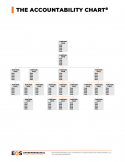
Map your structure, roles, and ownership so everyone knows who’s accountable for what.
Agree on What Each Manager Owns
Clarifying management responsibilities starts with making sure you and your managers agree on the results they’re accountable for, the authority they have, and when they need to involve you.
Start with one management role where questions or responsibilities regularly come back to you.
Talk through what you expect that manager to own and ask how they understand the role. You may discover that you’ve been operating with different expectations all along.
Resolve those differences before asking the manager to take greater ownership. Agree on which decisions they should make independently, what circumstances require your involvement, and how you’ll review progress.
Then give the manager room to do the job. That includes supporting their decisions and directing employees back to them when appropriate.
The free Accountability Chart can help you clarify the major responsibilities of each seat and establish clear ownership throughout your business.
If you’re struggling to get your managers and leadership team on the same page about who’s responsible for what, consider scheduling a free 90-Minute Meeting. Your leadership team can learn about the EOS Model and EOS Process and decide whether EOS is a fit for your business.
Ready to implement EOS?
An EOS Implementer helps your team install the full system and execute it with confidence.
Frequently Asked Questions
What should a manager be accountable for in a growing business?
A manager should be accountable for their team’s results and for leading, managing, and supporting employees as they do their work. In EOS, we call this LMA (Leadership, Management, and Accountability). The principle is simple: great leadership plus great management equals accountability.
Which responsibilities should stay with a manager instead of the business owner?
Routine team decisions, employee feedback, and follow-through on commitments should stay with the manager when they have the authority to handle them. The EOS Accountability Chart helps define each seat’s major responsibilities, making it clearer what the owner should hand over and when to step in.
Can a manager still do individual contributor work?
A manager can still do individual contributor work if the role calls for it and leaves enough time to lead their team. EOS defines each seat by its major responsibilities, so hands-on work shouldn’t crowd out the manager’s responsibility to lead, manage, and hold people accountable.