
What is an Accountability Chart?
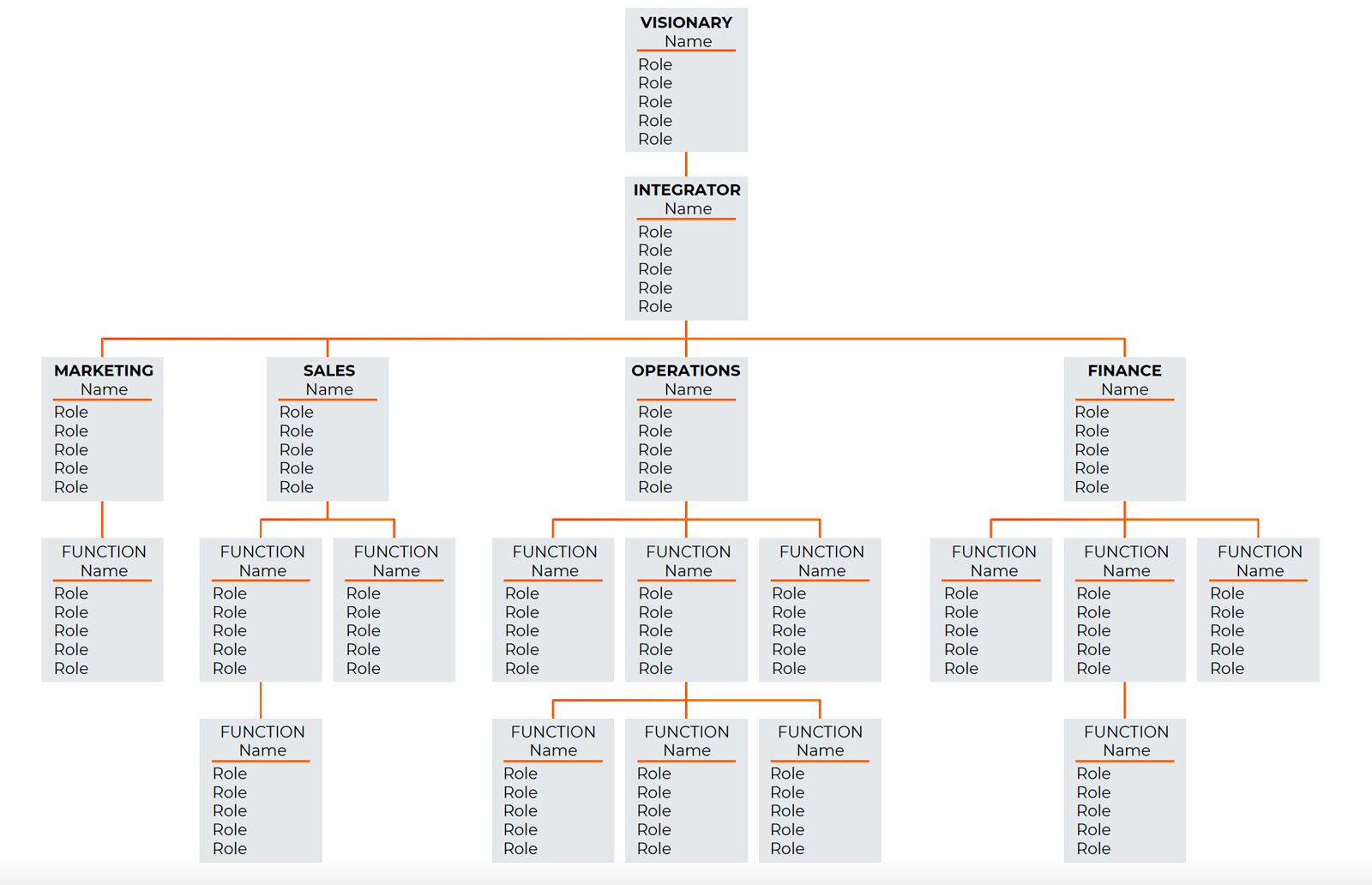
The Accountability Chart™ is the EOS® tool that defines the right structure for your company, independent of the people who fill the seats today. It shows every major function (seat) in the company, what that seat is accountable for, and who owns it. The Accountability Chart replaces the traditional org chart with a clearer question: not who reports to whom, but who owns what.
Next to the V/TO™, the Accountability Chart has the most impact of any EOS tool. It forces leadership teams to confront structural confusion that most companies tolerate for years.
Why the Accountability Chart exists
Traditional org charts show reporting relationships. They rarely answer the question that actually matters: who is accountable for this outcome?
Ambiguity in structure creates ambiguity in execution. When two people share accountability, neither is accountable. When a function has no clear owner, it underperforms. When roles are blurred, the best performers end up doing everyone else’s work.
The Accountability Chart solves this by forcing clarity. Every seat has a single owner. Every owner has five to seven major roles they are accountable for. The whole company can see, on one chart, exactly who owns what.
The three-question foundation
The Accountability Chart starts with a fundamental belief: there are only three major functions in any business.
- Sales and Marketing. Generating demand and closing new business.
- Operations. Delivering the product or service.
- Finance and Administration. Managing the money and the business infrastructure.
Everything else rolls up into one of those three.
Above those three major functions, most companies need two more seats:
- Integrator™. The person who harmoniously integrates the major functions, holds the leadership team accountable, and runs the business day-to-day.
- Visionary™. The person who owns the vision, generates the big ideas, maintains the culture, manages key external relationships, and pushes the company forward.
Some companies combine the Visionary and Integrator into one person. Most do not, because the skills required are fundamentally different.
Visionary vs. Integrator
The Visionary is typically the founder or owner. They are idea-rich, culture-obsessed, and energized by big-picture thinking. They struggle with details, routines, and holding people accountable. They are often a Kolbe QuickStart.
The Integrator is the right-hand person. They are operationally disciplined, execution-focused, and energized by running the business. They hold the team accountable, resolve conflicts, and integrate the major functions. They are often a Kolbe Fact Finder or Follow Through.
When a Visionary and Integrator are matched well, the combination is called Rocket Fuel. The company accelerates. The Visionary gets to do what they love. The Integrator gets to run the business. Everyone wins.
How to build an Accountability Chart
Step 1: Start with the right structure, not the current people
Put the current leadership team aside. Ignore job titles. Ignore reporting lines. Start from the question: what structure does this company need to grow and thrive?
Step 2: Define the top three functions
Every company has Sales and Marketing, Operations, and Finance and Administration. Sometimes the functions have different names (Revenue, Delivery, Business Services) but the roles are the same.
Step 3: Add the Integrator and Visionary seats
The Integrator sits above the three major functions. The Visionary sits above or beside the Integrator. Even if the same person fills both today, draw them as separate seats.
Step 4: Define five to seven roles per seat
Each seat is accountable for five to seven major roles. These are the outcomes the seat owner must deliver. Not activities. Outcomes.
Example. Sales/Marketing seat roles:
- Lead Generation
- New Business Development
- Sales Team Leadership
- Marketing Strategy Execution
- Pricing
- Competitive Intelligence
Step 5: Build the structure below
Under each of the three major functions, add the department heads and their roles. Under each department head, add their direct reports. Continue down the chart until every employee has a seat.
Step 6: Put names in the seats
Only after the structure is complete do you put names in the seats. This is where it gets hard. Some people will not fit in any seat. Some seats will be empty. Some people will fit in a different seat than they currently hold.
Step 7: Use GWC to evaluate fit
For each person in each seat, ask: does this person Get it, Want it, and have the Capacity to do it?
- Get it. Do they truly understand the role, the responsibilities, the culture, and the expectations?
- Want it. Do they genuinely want the job? Not just the title or the paycheck. The actual work.
- Capacity. Do they have the time, skills, emotional capacity, and intellectual capacity to do the job well?
All three must be a yes. If any is a no, they are in the wrong seat.
The Right Person, Right Seat test
The Accountability Chart answers the Right Seat question. Core Values answer the Right Person question.
- Right Person. Do they share your Core Values?
- Right Seat. Can they GWC™ the roles in their seat?
Right Person + Right Seat = the person stays and thrives.
Right Person + Wrong Seat = move them to a different seat.
Wrong Person + Right Seat = coach them on Core Values, and if that fails, they leave.
Wrong Person + Wrong Seat = they leave.
This is the most important framework in EOS for people decisions.
Common Accountability Chart mistakes
- Starting with people instead of structure. If you design the org chart around the people you have, you end up with a chart that protects egos instead of serving the business.
- Multiple people owning one seat. Every seat has one owner. Two owners means zero owners.
- Too many seats reporting to one person. The human span of control is five to seven direct reports. More than that, and no one gets managed well.
- Skipping the hard conversations. The Accountability Chart surfaces problems you have been avoiding. That is the point. Do not paper over them.
- Not revisiting quarterly. As the company grows, the chart must evolve. Review it every quarter.
How the Accountability Chart connects to the rest of EOS
- V/TO. The Accountability Chart is the structure needed to execute the V/TO.
- Core Values. Used to evaluate Right Person.
- GWC. Used to evaluate Right Seat.
- People Analyzer™. Combines Core Values + GWC into a systematic quarterly review.
- Rocks™. Each seat owner is responsible for their Rocks.
- Scorecard™. Each seat owner has measurables.
Frequently Asked Questions
What is the difference between an Accountability Chart and an org chart?
An org chart shows who reports to whom. An Accountability Chart shows who is accountable for what. The Accountability Chart is built around functions and outcomes, not titles and hierarchy.
Can the Visionary and Integrator be the same person?
In small companies, yes. As a company grows, the two roles should split. The skills required are fundamentally different and the workload is too much for one person.
How many levels should an Accountability Chart have?
As many as you need to show every employee in a seat. Most companies have four to six levels.
What if a person does not fit any seat?
Then they are in the wrong company. This is one of the hardest truths the Accountability Chart reveals. Use it honestly.
Is Accountability Chart trademarked?
Yes. Accountability Chart is a trademark of EOS Worldwide.
How often should we update the Accountability Chart?
Review it every quarter. Update it whenever the structure changes: new hires, promotions, departures, role changes.
Related EOS Tools
Build the Right Structure for Your Business
Ready to get the right people in the right seats? Start with a Free 90-Minute Meeting with a Professional EOS Implementer.
Written by EOS Worldwide
Reviewed by Mark O'Donnell, Visionary & CEO, EOS Worldwide
EOS Worldwide is the organization behind the Entrepreneurial Operating System®. Content reflects official EOS® doctrine.