

The EOS Organizational Checkup reveals the strength of your business across the Six Key Components: Vision, People, Data, Issues, Process, and Traction.
It helps your leadership team see where alignment is strong, where it’s breaking down, and which Issues need attention next.
One leader may think the Vision is clear. Another may see confusion across the company. One may believe accountability is strong. Another may see Rocks slipping, Issues repeating, and decisions getting reopened. They’re working in the same company, but they’re not seeing the same reality.
The EOS Organizational Checkup brings those different views into the open so your leadership team can see the gaps, talk about them, and turn them into Issues to solve.
What Is the EOS Organizational Checkup?
The EOS Organizational Checkup is a simple assessment that measures the strength of your business across the Six Key Components of the EOS Model:
- Vision
- People
- Data
- Issues
- Process
- Traction
Together, these components help your leadership team see whether the company is clear on where it’s going, has the Right People in the Right Seats, runs on Measurables, solves Issues at the root, follows Core Processes, and consistently gains Traction.
The Checkup matters because business results rarely tell the whole story. Strong numbers can hide weak alignment, unclear accountability, people Issues, or inconsistent Process.
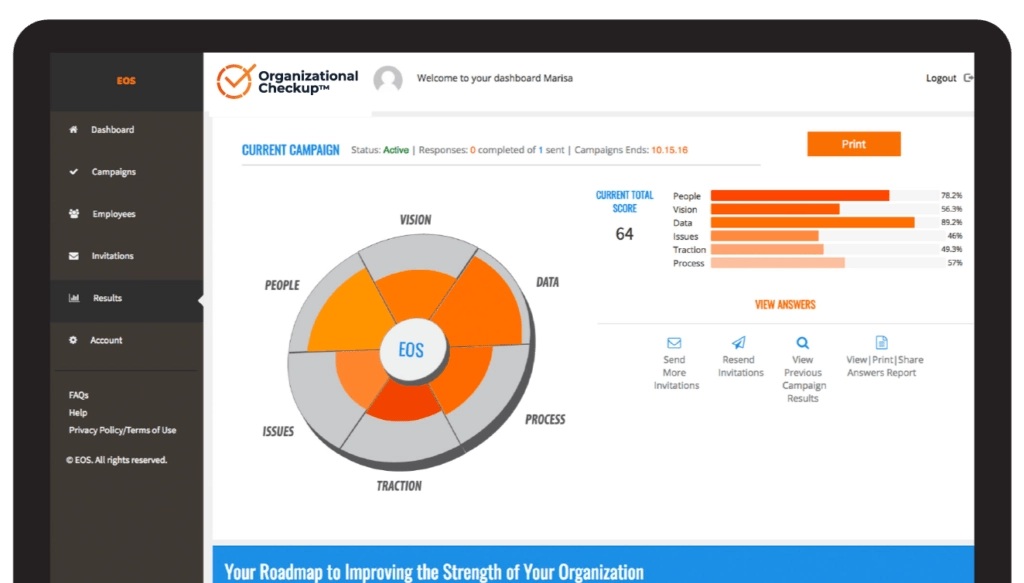
Take the EOS Organizational Checkup to see how your company performs across the Six Key Components and identify where you need greater focus.
What the Numbers Don’t Show
Revenue, profit, cash, sales, and customer retention matter. They show how the business performed. A company can hit its sales goal while depending too much on a few key people. It can grow while tolerating weak accountability. It can produce strong results while leaders send mixed messages, avoid hard conversations, or run the business on opinions instead of Data.
What the EOS Organizational Checkup Reveals
The Checkup helps smoke out the Issues that are slowing the business down.
1. Whether Your Leaders Share the Same Vision
A business can’t gain Traction when the leadership team isn’t 100% on the same page with where the company is going and how it’s going to get there.
Low Vision scores may point to leaders using similar words while seeing different futures.
Signs your Vision needs attention include:
- Leaders describe the future differently
- Priorities change too often
- Decisions keep getting reopened
- Employees hear mixed messages
- Teams work hard in different directions
2. Whether You Have the Right People in the Right Seats
People Issues drain a company quickly, especially when leaders avoid them.
The Checkup helps reveal whether people fit your Core Values and whether they’re in seats where they can succeed.
Signs your People Component needs attention include:
- Poor behavior gets tolerated because someone gets results
- Good people sit in seats that don’t fit
- Managers avoid hard conversations
- Employees aren’t clear on what “great” looks like
- The same people Issues keep resurfacing
3. Whether You’re Running on Facts or Feelings
Many leadership teams rely on statements like “sales feel better,” “production seems stronger,” or “people seem happier.” That may be true, but it isn’t enough.
The Data Component helps you run the business on objective Measurables. The Checkup helps reveal whether your leadership team has the visibility it needs to spot Issues early and make better decisions.
When Data is weak, surprises become normal. Problems surface late, and leaders debate opinions instead of facts.
4. Whether You’re Solving Issues at the Root
Every business has Issues. Strong businesses solve them.
Low Issues scores may indicate a team that revisits the same problems week after week instead of solving them at the root.
Signs your Issues Component needs attention include:
- The same Issues keep coming back
- Meetings produce discussion without decisions
- People bring symptoms instead of root causes
- Hard topics get avoided
- Leaders leave without a clear resolution
5. Whether Your Processes Are Followed By All
Process isn’t bureaucracy. It’s clarity about how the important work gets done.
The Checkup reveals whether your Core Processes are documented, simplified, and Followed By All. When Process is weak, everyone has their own way of doing things. Customers get inconsistent experiences. Training takes longer than it should. Quality depends on who happens to do the work that day.
Strong Process creates consistency, which gives people more freedom to do great work.
6. Whether You’re Actually Gaining Traction
Vision without Traction creates frustration.
Low Traction scores may point to weak discipline, unclear accountability, missed Rocks, ineffective Level 10 Meetings, or a weak Meeting Pulse.
Signs your Traction Component needs attention include:
- Priorities don’t get finished
- Deadlines slide
- People don’t own outcomes
- Meetings lack focus
- The same goals carry over quarter after quarter
Gaining Traction means your team executes on the Vision one week and one quarter at a time.
How To Use Your Organizational Checkup Results
Don’t treat your score like a grade. A low score isn’t failure. It’s information.
The real value of the Organizational Checkup is not the score alone. It’s the conversation the score creates. If one leader scores Vision a nine and another scores it a three, the team has uncovered an Issue. Do not debate the score. IDS the gap, get clear on what each leader is seeing, and solve the real Issue.
After your leadership team completes the Checkup, keep the next step simple:
- Find the lowest scores.
- Look for the biggest gaps between leaders.
- Turn those gaps into Issues.
- Solve the most important Issue first.
Ask:
- Where are we weakest right now?
- Where are we least aligned?
- What Issue should we solve first?
That’s how the Checkup becomes useful. Not by completing it, but by acting on what it reveals.
A Clearer View of the Business
Every owner wants a stronger business. That happens when the leadership team gets clear on the Vision, puts the right People in the right seats, runs on Data, solves Issues, follows Core Processes, and gains Traction.
Take the EOS Organizational Checkup to get a clear snapshot of your company’s strength across the Six Key Components. Then schedule a 90-Minute Meeting with an EOS Implementer to discuss your results and whether EOS is the right fit.
FAQ
What is the EOS Organizational Checkup?
The EOS Organizational Checkup is a simple assessment that measures the strength of your business across the Six Key Components of the EOS Model: Vision, People, Data, Issues, Process, and Traction.
It helps your leadership team see where the business is strong, where it needs attention, and where alignment is breaking down.
How do you evaluate your business performance?
To evaluate business performance, start with the numbers: revenue, profit, cash, sales, customer retention, and the key Measurables on your Scorecard. Those show how the business performed.
Then look at the strength of the business behind those numbers. The EOS Organizational Checkup helps evaluate whether the business has the clarity, accountability, consistency, and discipline to keep performing.
What are signs your business isn’t aligned?
Common signs your business isn’t aligned include shifting priorities, unclear goals, mixed messages, weak accountability, recurring Issues, and leaders leaving meetings with different interpretations of what was decided. You may also see departments blaming each other, employees unclear on where the company is going, or the owner carrying too much of the business. Those signs don’t mean the business is broken. They mean something needs to be strengthened.
Ready to Strengthen Your Business?
An EOS Implementer can help your leadership team address the gaps revealed by your Organizational Checkup and strengthen your Six Key Components.