

If you’re using the Level 10 Meeting well, it should help your team stay focused, solve Issues, and keep Rocks moving forward every week.
And yet, some companies running on EOS find that their Level 10 Meetings start to feel like status updates, long discussions, or meetings that don’t make enough progress.
When that happens, the agenda usually is not the problem. More often, the team has drifted from the discipline of the process: reporting sections turn into discussion, Issues are not clearly identified, To-Dos are not completed, and the real conversation never fully happens.
A strong Level 10 Meeting should consistently be rated 8.75+, with the team leaving confident that the most important Issues were identified, discussed, and solved.
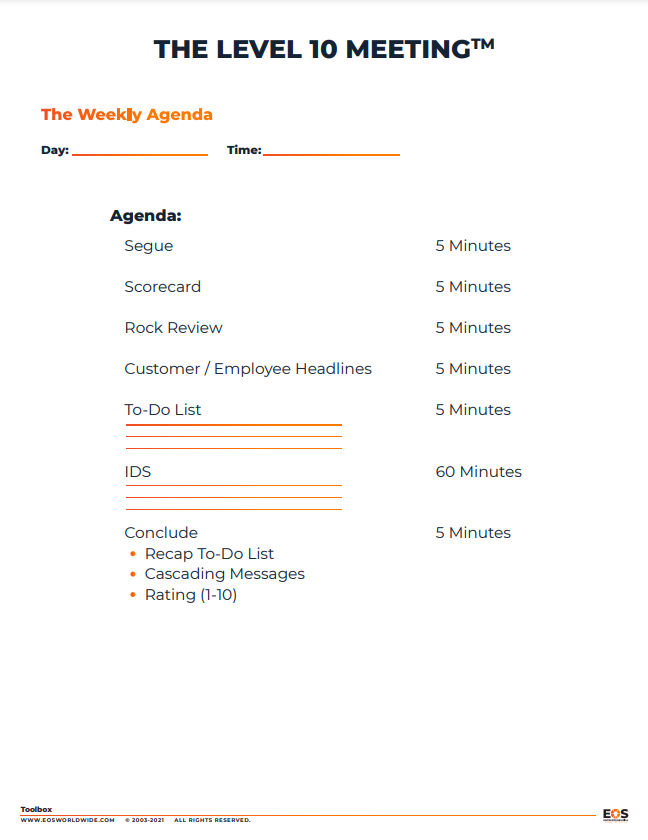
Download the agenda and follow along as you learn how to run an effective Level 10 Meeting.
The simplest way to hold a great Level 10 Meeting is to:
- Start and end on time every week
- Stop discussions during reporting sections
- Prioritize Issues before discussing them
- Spend more time identifying root causes
- Hold firm on To-Do accountability
- Encourage healthy, respectful conflict
- Come prepared with updated measurables and Rocks
- Discuss improvement opportunities when rated below 8.75
But this may be easier said than done for your team. You already know this, but the organizations getting the most value from Level 10 Meetings aren’t necessarily the ones with the most experienced leaders, the smartest people in the room, the longest-tenured employees, or the most years in business. They’re just made of people who commit to the discipline of the process.
It’s going to take a little bit of practice to weed out the damaging habits, assumptions, and meeting behaviors that EOS is designed to replace so you can finally make meaningful progress.
Unproductive Level 10 Meetings Have the Same Root Causes
Most disappointing Level 10 Meetings can be traced back to the same handful of triggers. Once you recognize them, they become easier to spot in your own meetings. And they’re usually fixable with a few adjustments and a renewed commitment to the process.
The top five common causes of frustrating Level 10 Meetings:
- Discipline Breakdowns
- Poor Issue Identification
- Misplaced Priorities
- Conflict Avoidance
- Weak Accountability
Let’s take a closer look at what each one looks like in practice so you can keep an eye out for them and start getting used to course-correcting them in real time, every Level 10 Meeting.
Related Reading: What Does The Perfect Level 10 Meeting Look Like?
1. Discipline Breakdowns
The Level 10 Meeting agenda is purpose-built. The reporting sections exist to gather information and identify Issues. IDS exists to solve them. But some companies blur those lines by turning every agenda segment into an opportunity for detailed, maybe long-winded, discussion. The meeting transforms a forum for identifying, discussing, and solving the most important Issues into a lackluster status update session.
This happens to many teams during the Scorecard review. A measurable is off track, so the owner starts explaining. Someone asks a follow-up question. Another person offers context. The team gets ten minutes into a chat that should have taken ten seconds. We see the same thing happening during Rock reviews, Headlines, and To-Do reviews. Instead of reporting and moving on, the team begins solving problems before they’ve even reached the Issues List.
Discipline breakdowns may also show up before the meeting even starts. Team members arrive late, forget to update their Scorecard measurables, or don’t take the time before the Level 10 Meeting to consider their Rock progress. They spend the meeting reacting to information for the first time. People may be physically present but mentally somewhere else entirely. When the meeting lacks focus and structure from the beginning, it’s that much harder to generate engagement and momentum.
The Quick Fix: The simple EOS principle of “drop it down” exists for a reason. If something requires discussion, put it on the Issues List and keep moving.
2. Poor Issue Identification
Solving the wrong issue is just as frustrating as not solving one at all. And many people are excellent at discussing Issues, but not so great at identifying them first.
Let’s say your revenue number comes in below target, and you drop it down to IDS. Sales starts the discussion on lead volume, marketing discusses campaign performance, and operations discusses capacity. Twenty minutes later, nobody has actually agreed on why revenue missed the target in the first place.
This is why the first step of IDS is Identify. Teams rush through the Identify part of an issue because offering up solutions feels productive. But spending more time uncovering root causes makes the rest of the conversation shorter and more effective. If the same issue keeps resurfacing, there’s a good chance the team has been treating symptoms rather than solving the underlying problem.
The Quick Fix: Resist the urge to jump straight into solutions. Before discussing what to do, make sure the team agrees on what problem you’re actually trying to solve.
3. Misplaced Priorities
Not every issue deserves equal attention, yet many teams treat them that way. The result is a Level 10 Meeting packed with chatter and activity but short on true meaningful progress.
Sometimes this happens because the Issues List becomes a collection of complaints instead of the most important Issues to solve. Minor frustrations, random thoughtful observations, lofty innovation ideas, and generally low-impact concerns start competing for attention alongside major business obstacles. Other times, the team gets distracted by whatever issue seems most urgent in the moment rather than what is most important to the business.
Focus on being effective, not just efficient. You may move quickly through a long list of topics and still feel okay, since everything received some level of attention. Meanwhile, the problem with the biggest drag on your growth goes unresolved and sinks its claws into other areas of the business. Great Level 10 Meetings are not measured by the sheer number of Issues raised. They’re measured by whether the right Issues get solved.
The Quick Fix: Ask yourself which Issue will create the greatest positive impact if solved. Let time run out on the less important topics, not the ones creating the biggest obstacles for your team.
4. Conflict Avoidance
Everyone knows the real issue. Nobody wants to say it out loud. Many unresolved Issues are not only Process Issues. They are People Issues.
Nobody wants to create tension, hurt feelings, or make a meeting uncomfortable. So again, we default to dancing around the actual concern by surveying symptoms. But healthy conflict is not about creating arguments or encouraging confrontation for its own sake. It’s simply being honest enough to solve problems. Conflict avoidance can also look like a few voices dominating the discussion while others disengage, limiting the healthy debate and diverse perspectives that lead to better solves.
Some of the longest chats in a Level 10 Meeting can be wrapped up in a fraction of the time if someone voiced what everyone was already thinking. Respectful candor and humbleness strengthen trust; they don’t damage it. And trust is so important in Level 10 Meetings and in running your business.
The Quick Fix: Encourage all team members to be candid, not combative. Honest conversations in which people feel safe to speak up solve more Issues than careful tiptoeing ever will.
5. Weak Accountability
One final mishap can happen after the Level 10 Meeting ends. Decisions are made, To-Dos are assigned, and everyone leaves the meeting feeling optimistic. Then next week comes, and no one has completed any To-Dos. The quarter ends, and only a few Rocks are finished.
Weak accountability often starts with good intentions. A team member offers to help by taking ownership of a To-Do, but then they get busy, work on another priority, or wait for information from someone else. Those explanations may be valid, but they don’t change the fact that the commitment wasn’t fulfilled. Exceptions lead to gray areas where accountability is subjective rather than measurable.
Remember to keep things simple: A To-Do is either done or not done, and a Rock is either on or off track. When teams consistently fall short of the expected completion rate, there’s a deeper roadblock you need to work through together. This means everyone must invest in clear ownership, consistent follow-through, and a willingness to address missed commitments.
The Quick Fix: Stop offering an A+ for effort. Progress comes from completed To-Dos and Rocks, not good intentions.
Frequently Asked Questions About Level 10 Meetings
What does L10 mean in corporate environments?
“L10” is a common shorthand for the EOS Level 10 Meeting. In EOS, a Level 10 Meeting is a structured weekly meeting that helps teams stay focused, review Scorecard numbers and Rocks, identify Issues, create accountability for To-Dos, and solve the most important Issues using IDS.
Why is it called an L10?
The name of the Level 10 Meeting and its shorthand “L10” come from the practice of rating the meeting at the end on a scale of one to 10. The goal is for the team to consistently rate the meeting an eight or higher because the meeting was focused, useful, and helped solve the most important Issues.
That rating gives the team a simple way to improve the meeting each week while staying committed to the Level 10 Meeting agenda and the discipline of the EOS Process.
Why aren’t my Level 10 Meetings effective?
Most ineffective Level 10 Meetings result from teams drifting away from the EOS process. Common causes include discussing Issues during reporting sections, failing to identify root causes, arriving unprepared, avoiding difficult conversations, or failing to hold people accountable for To-Dos.
How do you fix unproductive team meetings?
Start by tightening meeting discipline. Follow a consistent agenda, start and end on time, limit discussions to the IDS portion of the meeting, prioritize Issues before solving them, and assign clear ownership for To-Dos. Small improvements in consistency produce significant gains in meeting effectiveness.
How long should a Level 10 Meeting last?
The standard EOS Level 10 Meeting lasts 90 minutes and follows a structured agenda that allocates specific time blocks to Scorecard reporting, To-Do accountability, IDS using the Issues List, and conclusion activities. Sticking to those time limits helps teams stay focused and productive.
What Your Level 10 Meeting Is Trying to Tell You
A frustrating Level 10 Meeting is usually a signal. Something needs to be brought into the open, clarified, owned, or solved.
That is the real value of the meeting. It gives your team a weekly place to see the truth, say the truth, and solve what matters most. When the meeting starts feeling heavy, repetitive, or unproductive, do not write it off as “just another bad meeting.” Use it as a clue.
That is why EOS Implementers pay close attention to how the team works together, not just whether it is following the agenda. An experienced Implementer can help spot the habits behind recurring Issues, stalled decisions, and frustrating meeting dynamics, then help the leadership team get back to the discipline of the EOS Process.
If your team keeps running into the same patterns, start with a 90-Minute Meeting. You will walk through the EOS Model, identify your biggest challenges, and get a clearer picture of what is getting in the way of progress.
Ready to Fix Your Level 10 Meetings?
An EOS Implementer can help your leadership team run focused meetings, solve issues at the root, and turn weekly discussion into real execution.