


What Are EOS Rocks™?
Rocks are the three to seven most important priorities that a company, department, or individual must complete in the next 90 days. Rocks create a 90-Day World. They turn a one-year plan into focused, bite-size chunks that a team can actually execute. Each Rock is specific, measurable, and attainable, with a single owner and a clear due date.
Rocks are one of the most powerful tools in EOS. They solve the universal problem of trying to do everything at once and getting nothing done.
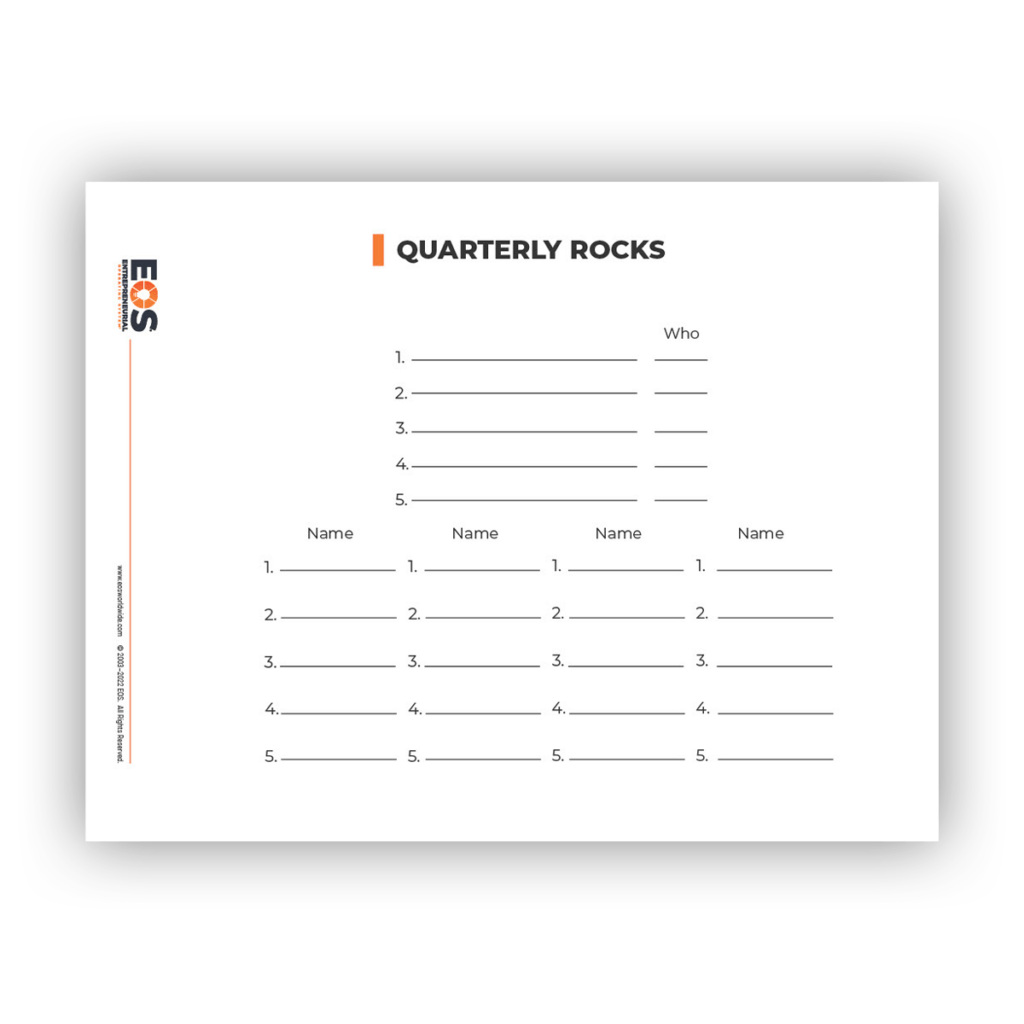
A simple worksheet to help your team define clear 90-day priorities, assign ownership, and stay accountable throughout the quarter.
Why Rocks exist
Most organizations start the year with a long list of priorities and finish the year having accomplished almost none of them. The problem is not effort. The problem is focus.
Rocks fix this by forcing a choice. Three to seven priorities per quarter. No more. The team commits. The team executes. The team measures at 90 days.
The name comes from an analogy popularized by Stephen Covey in First Things First, then adapted by Verne Harnish. Picture a glass cylinder. Next to it, you have rocks, gravel, sand, and water. The cylinder is your time. The rocks are your true priorities. The gravel is your day-to-day work. The sand is the interruptions. The water is everything else.
If you pour in the water, sand, and gravel first, the rocks never fit.
If you put the rocks in first, everything else fills in around them and it all fits.
Rocks go in first.
What makes a good Rock
A Rock must be specific, measurable, and attainable. Ambiguity kills Rocks.
Good Rocks:
- Close $1 million in new business
- Hire a new Controller
- Document the customer onboarding process and train all customer success reps
- Narrow CFO candidates to two finalists
- Launch the new website
Bad Rocks:
- Improve sales
- Work on culture
- Start thinking about hiring
- Get the team aligned
The test is simple. At the end of the quarter, can anyone in the room say without debate whether the Rock is done?
Yes means it is a good Rock. Ambiguity means it is not.
How to set Rocks: the 8-step process
Step 1: Brainstorm
After reviewing your V/TO™, the leadership team lists everything on a whiteboard that needs to be accomplished in the next 90 days. You will typically land on 10 to 20 items. One client once came up with 75.
Step 2: Narrow the list
Debate and discuss. Make a decision on each one: keep it, kill it, or combine it. Keep narrowing until you have the three to seven most important priorities for the company this quarter. The right ones rise to the top.
Step 3: Set the due date and define each Rock
Set the due date (typically end of the quarter: March 31, June 30, September 30, December 31). Then define each Rock clearly. Specific, measurable, attainable.
Step 4: Assign a single owner
Each Rock must be owned by one person. When more than one person is accountable, nobody is accountable. The owner drives the Rock to completion: creates the timeline, calls the meetings, pushes the work forward.
Step 5: Individual Rocks
Once company Rocks are set, each leadership team member sets their own Rocks. First, they carry forward any company Rocks they own. Then they add their most important three to seven individual Rocks.
Step 6: Create the Rock Sheet
Create a one-page landscape Rock Sheet. Company Rocks at the top. Individual Rocks below. Bring it to every Level 10 Meeting™. This sheet drives the weekly Rock Review.
Step 7: Share with the organization
Share the company Rocks with every employee in the quarterly State of the Company meeting. The vision must be shared by all. Everyone deserves to know what matters this quarter.
Step 8: Cascade to departments
Each department sets their Rocks using the same process. Every employee ends up with their own Rocks for the quarter. Leadership team members should have three to seven Rocks. Everyone else should have one to three.
How many Rocks should a company have?
Three to seven. Closer to three is better.
The temptation is always to do more. Resist it. When everything is important, nothing is important. Less is always better. A few priorities executed brilliantly beats a long list executed poorly.
For individual employees outside the leadership team, the cap is three. Leadership teams can stretch to seven. Department-level Rocks should rarely exceed five.
Why Rocks are 90 days
Ninety days is the maximum human attention span for a priority. Longer than that, and focus drifts. The work slides. Quarters are also the natural rhythm of business: annual goals break cleanly into four quarters, and each quarter creates natural energy and accountability.
The 90-Day World also builds in a safety net. If you set the wrong Rocks, you only lose one quarter before you correct course. If you set the right ones, you compound four times per year.
Tracking Rocks in a Level 10 Meeting
Every Level 10 Meeting includes a 5-minute Rock Review. Each owner reports on-track or off-track. No discussion during the review. If a Rock is off-track, it drops to the Issues List for IDS.
On-track means the owner is confident they will complete the Rock by the end of the quarter. Off-track means they are not.
Do not let owners fudge this. An honest off-track is more valuable than a dishonest on-track.
Common Rock mistakes
- Garbage in, garbage out. If you set the wrong Rocks, you spend a whole quarter pointed in the wrong direction. Spend the time to set them right.
- Too many Rocks. More than seven for leadership, more than three for individuals, is a recipe for nothing getting done.
- Vague Rocks. “Improve the onboarding experience” is not a Rock. “Launch new onboarding workflow and train all 12 reps by March 31” is.
- Shared ownership. Two people owning a Rock means no one owns it. One owner per Rock.
- Adding Rocks mid-quarter. Once the quarter starts, no new Rocks. New ideas go on the V/TO Issues List for next quarter.
- Commitment fizzle. Starting strong and fading by week four. Rocks need discipline every week, not just every quarter.
How Rocks connect to the rest of EOS
Rocks sit inside the Meeting Pulse. Annual planning sets the yearly goals. Quarterly Pulsing sets the Rocks. The Weekly Level 10 Meeting tracks them. Every 90 days, the cycle repeats.
Rocks also connect to the V/TO. The Issues List at the bottom of the V/TO is where next quarter’s Rock candidates often come from. The 1-Year Plan breaks into Rocks. The Rocks break into To-Dos.
Frequently Asked Questions
What is the difference between a Rock and a to-do?
A Rock is a 90-day priority. A To-Do is a seven-day action item. Rocks drive the quarter. To-Dos drive the week.
How many Rocks should each person have?
Leadership team members: three to seven. Department managers: three to five. Individual employees: one to three.
Can a Rock be longer than 90 days?
No. The 90-day container is intentional. If the work takes longer, break it into multiple Rocks across multiple quarters.
What happens if a Rock is not completed?
Carry it forward to the next quarter only if it is still a top priority. Otherwise, let it go. A Rock that carries for three quarters was never a real priority.
Is “Rock” the same as a SMART goal?
Rocks are SMART goals applied to a 90-day window with a single owner. They share the specific, measurable, and attainable principles.
Is EOS Rocks trademarked?
Yes. The EOS Rocks methodology and related terms are trademarks of EOS Worldwide.
Related EOS Tools
- V/TO. Where Rocks come from.
- Scorecard™. Measures weekly progress on what matters most.
- Level 10 Meeting. Where Rocks get reviewed every week.
- Meeting Pulse. The quarterly Pulsing Session is where Rocks get set.
- Issues List. Where Rock candidates often originate.
Start Setting Rocks That Get Done
Ready to turn your priorities into progress? Start with a Free 90-Minute Meeting with a Professional EOS Implementer.
Written by EOS Worldwide
Reviewed by Mark O'Donnell, Visionary & CEO, EOS Worldwide
EOS Worldwide is the organization behind the Entrepreneurial Operating System®. Content reflects official EOS® doctrine.