
What is a Level 10 Meeting?
A Level 10 Meeting™ is the weekly, 90-minute leadership team meeting in the Entrepreneurial Operating System® (EOS®). It follows the same seven-part agenda every week: Segue, Scorecard, Rock Review, Customer and Employee Headlines, To-Do List, IDS, and Conclude. The name comes from the goal of rating the meeting a 10 out of 10 on effectiveness.
The Level 10 Meeting is the heartbeat of a company running on EOS. It is the moment of truth for accountability. Done right, it keeps leadership teams aligned, drives issues to resolution, and ensures the vision moves from paper to execution.
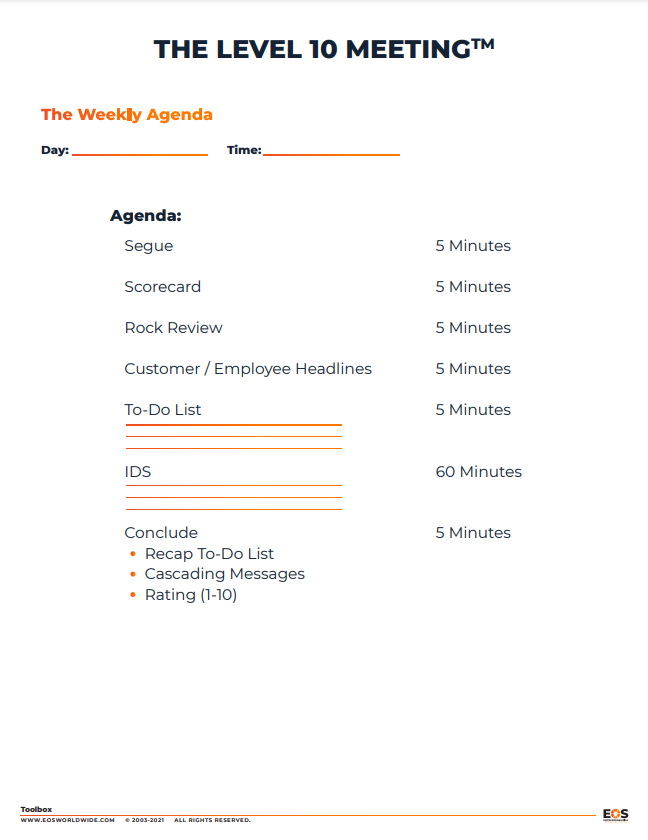
Download the agenda and follow along as you learn how to run an effective Level 10 Meeting.
Why the Level 10 Meeting exists
Most leadership meetings are a 4 or a 5 out of 10. They’re unfocused, too long, dominated by the loudest voice, and end without resolution. People leave unclear on what was decided.
The Level 10 Meeting solves this with structure. Same day. Same time. Same agenda. Every week. No exceptions except vacation or death.
When you commit to that structure, three things happen:
- Problems get surfaced weekly instead of festering for months
- Commitments get tracked and completed
- The leadership team stays on the same page, which cascades through the entire company
A weekly Level 10 Meeting keeps you focused on what’s important, helps you spot developing problems, and drives you to solve them.
The Level 10 Meeting agenda
The agenda is fixed. Never change it. The discipline of running the same agenda every week is what creates the traction.
How each section works
Segue (5 minutes)
Each person shares one personal best and one business best from the last week. The segue transitions the team from working in the business to working on the business. It disconnects people from day-to-day affairs and reminds everyone that you are human beings trying to create something great together.
Turn off phones and laptops. Take a breath. Change gears.
Scorecard (5 minutes)
Review the leadership Scorecard. Five to fifteen weekly numbers that give you an absolute pulse on the business. Each owner reports their number as on-track or off-track.
No discussion. If a number is off-track, drop it to the Issues List for the IDS portion of the meeting. The Scorecard review only identifies problem areas. It does not solve them.
Rock Review (5 minutes)
Review every Rock, one at a time. Company Rocks first, then individual Rocks. Each owner reports on-track or off-track.
No discussion. If a Rock is off-track, drop it to the Issues List. On-track means the owner is confident they will complete it by the end of the quarter.
Customer and Employee Headlines (5 minutes)
Short, tactical headlines about customers and employees. Good news and bad news. “Our biggest client just renewed.” “Sarah is concerned about the new process.” This is where the pulse of your people and customers surfaces.
Any concerns or bad news drops to the Issues List.
To-Do List (5 minutes)
Review every To-Do from last week’s meeting. Each To-Do is a seven-day action item, not a quarterly Rock. Each is either done or not done.
Strike completed To-Dos from the list. Leave incomplete To-Dos for one more week. A To-Do should not stay on the list more than two weeks. Ninety percent of To-Dos should drop off every week.
This agenda item alone creates more accountability in one month than most companies build in a year.
IDS: Identify, Discuss, Solve (60 minutes)
The heart of the meeting. This is where the magic happens.
Look at the Issues List. Identify the top three issues in priority order. Start with issue number one and work it until it is solved. Then move to number two. Then number three.
Do not work through the list top to bottom. Work in priority order. Often, the most important issue is buried at the bottom of the list, and solving it makes half the other issues disappear.
Identify, Discuss, Solve:
- Identify the real issue. Not the symptom. The actual root cause. Ask questions. Get underneath the surface. Most issues presented in meetings are symptoms, not root issues.
- Discuss the issue openly and honestly. Everyone shares their perspective. Fight for the greater good of the company, not the individual.
- Solve the issue forever. The solution almost always becomes one or more To-Dos for next week.
Great IDS is passionate, intense, exhausting, and never boring. No politics. Open and honest. Everyone fighting for the same vision.
Conclude (5 minutes)
Three things happen in the conclude:
- Recap the To-Do List. Restate every new To-Do created during IDS to confirm ownership and due dates.
- Cascading messages. Decide what needs to be communicated to the rest of the company from what was decided today. Who communicates it and how.
- Rate the meeting. Every person rates the meeting 1 through 10. The goal is an 8 or better. If the rating is below 8, the team discusses what would make it better next week.
End on time. Always.
Who should attend a Level 10 Meeting?
The Leadership Team. Typically five to seven people, always fewer than ten. Every seat on the top level of the Accountability Chart.
Once your leadership team masters the Level 10 Meeting, roll it out to every department. Department-level Level 10 Meetings are typically 30 to 60 minutes, not 90, but follow the exact same agenda.
The Five Points of the Weekly Meeting Pulse
A productive Meeting Pulse meets five criteria. Every Level 10 Meeting must:
- Be on the same day each week
- Be at the same time each week
- Use the same printed agenda
- Start on time
- End on time
Same day and time creates routine. Same agenda eliminates reinventing the wheel. Starting and ending on time protects the IDS portion, which is what matters most.
Common Level 10 Meeting mistakes
- Skipping weeks. The only acceptable reasons are vacation or death. Even if half the team cannot make it, run the meeting anyway.
- Drifting from the agenda. The temptation to discuss issues during the Scorecard review is constant. Resist it. Drop it to IDS.
- Working the Issues List top to bottom. Always work in priority order. The most important issue might be number eight on the list.
- Solving symptoms, not root causes. If you find yourselves discussing the same issue week after week, you have not identified the real issue yet.
- Rating the meeting a 10 out of politeness. Honest ratings make the meeting better. If it was a 6, say 6.
- Letting the meeting run over. Ending on time is a discipline. When meetings run over, they steal from the next appointment and the habit breaks.
How to start running Level 10 Meetings
You cannot run a true Level 10 Meeting without the rest of EOS in place. The Scorecard requires weekly numbers. The Rock Review requires quarterly Rocks. IDS requires an Issues List.
If your company is not yet running on EOS, start with the foundational tools. The V/TO, the Accountability Chart, Rocks, the Scorecard, and a clear Meeting Pulse. Then the Level 10 Meeting becomes the weekly rhythm that makes everything work.
Most companies learn EOS by reading Traction, implementing the tools with a Professional EOS Implementer, or working through a self-implementation path in EOS Academy.
Frequently Asked Questions
How long is a Level 10 Meeting?
Ninety minutes for the leadership team. Thirty to sixty minutes for department teams.
How often should a Level 10 Meeting happen?
Every week. Same day, same time, no exceptions.
Who runs the Level 10 Meeting?
Two roles are vital. One person runs the meeting and moves the team through the agenda. A second person manages the agenda, including the Scorecard, Rock Sheet, and Issues List updates.
What is the difference between a Level 10 Meeting and a regular team meeting?
A Level 10 Meeting has a fixed seven-part agenda, a 90-minute time box, and a commitment to the same day and time every week. It prioritizes issue-solving over status updates.
Can you run a Level 10 Meeting virtually?
Yes. Many leadership teams run virtual or hybrid Level 10 Meetings. The agenda and discipline are the same. Cameras on. Full attention. Same day, same time.
Is the Level 10 Meeting trademarked?
Yes. Level 10 Meeting is a trademark of EOS Worldwide.
How do I get started running Level 10 Meetings?
Start by reading Traction by Gino Wickman. Then work with a Professional EOS Implementer or begin a self-implementation path through EOS Academy.
Related EOS Tools
The Level 10 Meeting connects to nearly every other tool in the EOS Toolbox:
- Scorecard. Reviewed every meeting.
- Rocks. Reviewed every meeting.
- IDS. The heart of the meeting.
- Issues List. Where every problem lives.
- To-Do List. Where every commitment lands.
- Meeting Pulse. The Level 10 Meeting is the weekly expression of the full EOS Meeting Pulse.
Start Running Effective Level 10 Meetings
If your leadership team wants to run on EOS, start with a Free 90-Minute Meeting. An EOS Implementer will show you how the Level 10 Meeting and the rest of the system can transform how your team works.
Written by EOS Worldwide
Reviewed by Mark O'Donnell, Visionary & CEO, EOS Worldwide
EOS Worldwide is the organization behind the Entrepreneurial Operating System®. Content reflects official EOS® doctrine.