When someone understands the job, has been trained and coached, and still chooses not to follow through, you may not have a GWC issue. You may have a Right Person issue.
One of the hardest People decisions a leadership team has to make is what to do with someone who isn’t meeting expectations. Maybe they’re talented, or they’ve been with the company for years. Maybe they understand the job and have already been coached more than once. But the same issue keeps coming back.
That’s when we often hear something like this in the room: “We keep asking them to do it the right way, and they keep not doing it.”
The team usually goes straight to GWC.
- Do they Get it?
- Do they Want it?
- Do they have the Capacity to do it?
That’s a good question. In fact, it’s an essential EOS question. GWC is the EOS tool for determining whether someone is in the Right Seat on the Accountability Chart.
But sometimes, we go there too quickly.
If someone doesn’t understand the job, then yes, they may not Get it. If they don’t have the skill, horsepower, or bandwidth to do the job, then yes, they may not have the Capacity. If they no longer have the desire to do the job, then yes, they may not Want it.
But what about the person who does understand the job, knows what’s expected, has been trained and coached, and still chooses not to follow through?
That may not be a GWC problem. It may be a Right Person issue.
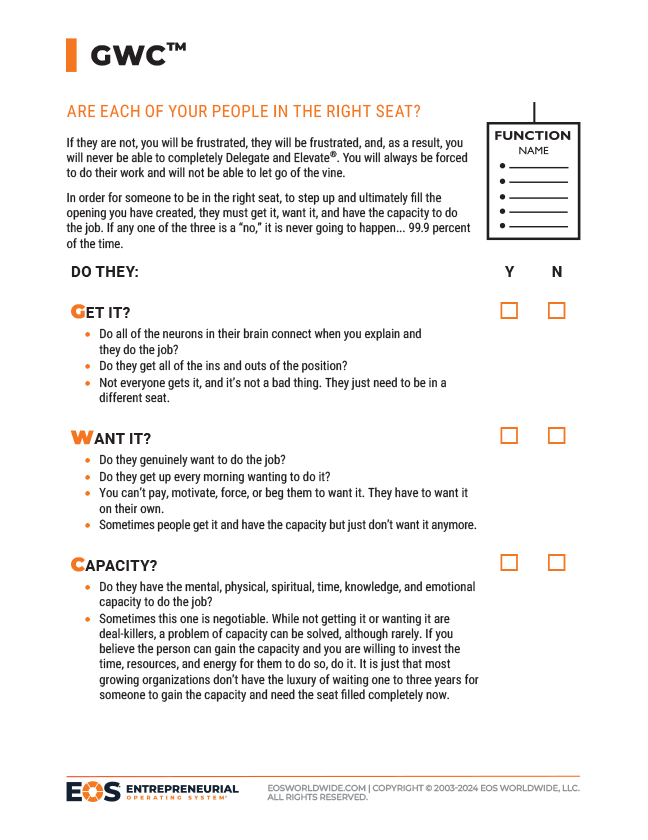
Find out whether someone Gets it, Wants it, and has the Capacity to do the role.
The Difference Between a Skill Gap & a Choice
There’s a big difference between someone who can’t do something and someone who chooses not to do something. A person who’s new, overwhelmed, undertrained, or unsure of the expectation may need leadership, coaching, resources, or a better-defined seat.
As leaders, we have to own that first. Before deciding there is a People issue, make sure the organization has done its part.
Ask:
- Do they know what’s expected?
- Have they been trained?
- Do they have the tools, time, and resources to do the job?
- Have they received direct feedback about the issue?
- Have they had a reasonable opportunity to correct it?
If the answer to one of those questions is no, start there.
If the answer is yes across the board, look at the behavior itself. Maybe they know they’re supposed to show up on time, but they continue showing up late. Perhaps they know the process but keep skipping steps. Or maybe they agreed to one way of doing the work but repeatedly choose their own.
Why Leaders Mislabel the Issue
GWC feels logical. It gives leadership teams a framework and common language for talking about a difficult People issue, which is one of the reasons the tool is so useful.
But logical tools can also become a place to hide from a harder conversation.
It’s easier to ask whether someone Gets it than to acknowledge that they understand exactly what’s expected and keep choosing something else. It’s easier to revisit training than to decide whether a talented employee is still the Right Person for the organization.
That’s especially true when the person produces results.
They may have customer knowledge, technical skill, institutional memory, or a personality everyone has learned to work around. Leaders start making exceptions because losing that person feels painful.
But talent doesn’t cancel out values.
In an EOS-run organization, being good at the job isn’t the same as being the Right Person. The Right Person consistently demonstrates the company’s Core Values, even though nobody does that perfectly every day.
Making exceptions for strong performers can send the rest of the organization the message that results matter more than the standards everyone else is expected to follow.
Use the People Analyzer to Get Specific
This is where the People Analyzer becomes useful.
Instead of saying, “They have a bad attitude,” “They don’t seem committed,” or “They’re driving everyone crazy,” compare the person’s behavior directly against the company’s Core Values.
Maybe the value is Accountability, Ownership, Team First, Do the Right Thing, Follow Through, Respect, or something unique to your company. Identify which Core Value is showing up as a +/-, or -, then determine whether the person is below The Bar overall.
Get specific:
- What exactly happened?
- How often has it happened?
- Is this a one-time mistake or repeated behavior?
- Has the expectation already been communicated?
- What would Above the Bar behavior look like instead?
That moves the discussion away from personality and frustration and toward observable behavior. It also helps the leadership team distinguish between someone who made a mistake and someone whose choices repeatedly conflict with the way the company has agreed to operate.
Have the Conversation Before You Re-Diagnose the Issue
Once you’ve identified a Core Values issue, don’t send the person back through another vague round of coaching.
Have a direct conversation about the specific behavior and the standard that needs to change.
It might sound like this: “Here is the Core Value where we see you falling Below the Bar. Here are the specific examples. Here’s what needs to change over the next 30 days.”
Then follow up. If the behavior changes, great. That’s the goal. If it doesn’t, have the next conversation rather than resetting the clock and starting the diagnosis all over again.
EOS teaches the Three-Strike Rule for someone below The Bar: discuss the issue and expectations, give them 30 days, repeat if needed, and if there is still no improvement after the third strike, they must go. Often, people who do not fit leave on their own because they know they do not fit.
That isn’t making the situation dramatic or personal. It’s confirming that both the employee and the leader know where things stand and what needs to happen next.
Process Issues Can Reveal People Issues Too
This same issue often shows up when companies struggle to get people to follow their Core Processes.
A leadership team documents the process, simplifies it, trains everyone, and rolls it out. At first, someone ignoring it may still be a training or communication issue. Maybe the process isn’t understood, doesn’t work as intended, or the employee lacks the resources to follow it.
But once those issues have been addressed, knowingly ignoring the agreed-upon process becomes an accountability issue.
I once told a CEO, “It sounds like your processes don’t have any teeth.” He asked, “What does it look like for a process to have teeth?”
The answer is accountability.
A process has accountability when everyone is trained, knows the right way, and is measured and managed to do it the right way every time. That doesn’t mean micromanaging people or creating a rigid rulebook. It means leadership treats the agreed-upon way of working like it matters.
If people can knowingly ignore a Core Process without consequence, the company shouldn’t be surprised when that process isn’t Followed by All.
When GWC Isn’t the Answer
Core Values help define what being the Right Person actually looks like inside your organization. They give leaders a standard for hiring, reviewing, recognizing, rewarding, and, when necessary, making difficult People decisions.
GWC is an incredibly valuable tool, but not every recurring People issue can be solved by running through Get it, Want it, and Capacity again.
Go back to your Core Values. Use the People Analyzer. Identify the pattern, address it directly, and create accountability around what needs to change.
Still debating whether you have a GWC issue, a Core Values issue, or an accountability issue? A free 90 Minute Meeting will help your leadership team see how EOS can strengthen your People Component and determine whether EOS is a good fit for your organization.
Ready to implement EOS?
An EOS Implementer helps your team install the full system and execute it with confidence.