Attract the right candidates, repel the wrong ones, and make clearer, more confident hiring decisions.
Hiring mistakes are expensive—financially, culturally, and emotionally. One of the greatest advantages of EOS is that it gives you simple, practical tools to bring more clarity and discipline to hiring decisions and increase the likelihood of finding the Right People in the Right Seats from the get-go.
So let’s talk about how to use EOS Tools to make each stage of the hiring process more intentional, objective, and fruitful.
Hire with a Clear Seat on the Accountability Chart
Before you post a job or interview a single candidate, you must have a defined seat on your Accountability Chart available and five key roles and responsibilities clearly articulated for that seat.
Use the seat’s roles as the foundation for the job description. Then share the Accountability Chart during interviews to explain where this seat sits in the organization, what the person will be accountable for, who they will work with, and which Measurables define success.
This helps candidates understand the seat, the accountabilities, and how the role fits into the bigger picture. Clarity here prevents mismatched expectations on both sides.
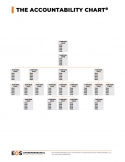
Map your structure, roles, and ownership so everyone knows who’s accountable for what.
Lead with Core Values (Attract & Repel)
Your Core Values are your most powerful hiring tool, if you actually use them. The goal is that every single hire joins your company only by deeply understanding, and self-selecting into, your Core Values.
You do this by including your Core Values in every job posting with strong, unapologetic language. Make it clear that:
- Only candidates who consistently live these values should apply
- Technical skills matter, but values alignment is non-negotiable
Tip: Avoid watered-down language. Strong values attract the right people and repel the wrong ones. That’s a feature, not a bug.
Then design interview questions that specifically assess how consistently a candidate already lives your Core Values. For example:
- “Tell me about a time you chose between doing what was easy and doing what was right.”
- “Which of our Core Values resonates most with you, and which feels most challenging?”
When you’re ready or further along in the interview process, you can also share your Core Values Speech. This can happen before interviews (via a pre-recorded video) or live during an interview.
By the end of the process, candidates should be able to explain what your Core Values look like in action or how they would embody them in their day-to-day at your company.
You want candidates walking away saying: “Wow, this company takes their Core Values seriously.” And you know you’ve used them well when some candidates opt out of the process because they don’t align with your Core Values. It’s better to find out now than later!
Share the Vision Using the V/TO
Your Vision/Traction Organizer (V/TO) is not just an internal alignment tool. It’s a powerful hiring filter.
Share your V/TO with final-stage candidates to articulate where the company is going, explain how you’ll get there together, and set expectations for pace, priorities, and culture.
You want the right candidates to feel energized and excited: “This is exactly the kind of company I want to help build.” You want the wrong candidates to self-select out: “This company is not for me.”
Hiring people who are genuinely excited about your Vision increases engagement, retention, and performance.
Clarify Expectations Using the Scorecard & Rocks
One of the fastest ways to avoid a mis-hire is to be crystal clear about what winning looks like in the role using your Scorecard and samples of Rocks.
These EOS Tools help candidates fully understand the results-oriented, accountability-driven culture they’re walking into.
If you already have Scorecard Measurables for the seat, share them during the interview process. Sharing Measurables upfront helps candidates understand how performance is objective and visible.
The right candidates will appreciate the clarity and say: “I know exactly what success looks like – and I’m excited about that.” The wrong candidates will feel uncomfortable or intimidated, which is exactly the point.
Rocks can be used to illustrate the nature of the work during interviews as well. If you have examples of Rocks previously owned by this seat, or potential Rocks this role may own in the future, share them with candidates.
Rocks help candidates understand the types of projects and priorities they’ll be responsible for, the pace and focus of the organization, and how much ownership and initiative is expected each quarter.
You reduce surprises after Day One when prospective team members know exactly how they’ll be measured (Measurables), what kind of impactful work they’ll own (Rocks), and what success looks like in concrete terms.
Complete the People Analyzer to Hire RPRS
The People Analyzer should be used by every person involved in evaluating a candidate for a final hiring decision.
Each interviewer independently assesses the candidate on:
- Core Values
- Do they consistently live them?
- Whether they GWC the Seat
- Get it
- Want it
- Have the Capacity to do it
Complete the People Analyzer before you discuss your thoughts on a candidate as a group. Compare results after interviews, looking for patterns, not outliers.
If you’re trying to talk yourself into hiring a candidate, pause. Let the People Analyzer do its job.
Assess Natural Strengths with Kolbe
The Kolbe A™ Index is an additional way to understand how someone naturally takes action, beyond the qualities that might assess their intelligence or work experience.
First, build an ideal profile for the role by completing the Kolbe A™ Index. Define the ideal instinctive modes of operation or strengths based on the work they’ll be doing and how they’ll interact with others.
Then have top candidates complete the Kolbe C™ Index to compare results against the ideal profile. Keep in mind that Kolbe does not determine hire vs. no-hire. Instead, it informs potential coaching needs, friction points, and the likelihood of long-term success in the seat.
The Outcome: Best-Fit, Energized Candidates
When you consistently use the EOS Tools in hiring, you move from hoping to disciplined decision-making.
- Accountability Chart creates the seat
- Core Values attract a cultural fit
- V/TO aligns people with your Vision
- Measurables and Rocks set expectations
- People Analyzer brings clarity and discipline to the decision
- Kolbe increases natural seat fit
Hiring the Right People, in the Right Seats starts before a résumé lands in your inbox. No system eliminates hiring risk entirely, but this one dramatically improves your odds.
Need some support during the process? A free 90-Minute Meeting shows your leadership team how EOS can help define the people, seats, expectations, and direction your company needs before making the next hire. Schedule yours today for immediate guidance and action steps.
Ready to implement EOS?
An EOS Implementer helps your team install the full system and execute it with confidence.