Team health holds the Six Key Components of EOS together by helping your leadership team trust each other, disagree openly, and hold each other accountable.
I was running through the Six Key Components as a refresher with a client one day, drawing them out on the whiteboard: Vision, People, Data, Issues, Process, and Traction. When I stepped back to look at it, I asked them a question I hadn’t planned on asking.
“What’s missing from this diagram?”
We tell every client that EOS helps leadership teams get three things: Vision, Traction, and Healthy. On the board, I could see the Vision part. I could see the Traction part.
But where was Healthy?
Healthy isn’t a seventh circle on the EOS Model. It’s what happens between the circles.
Those Six Key Components don’t operate in isolation. They interact all day long. And in my experience, the health of the leadership team affects how well those components work together.
When people trust each other enough to be honest, solve problems, and hold each other accountable, every component works better. When they don’t, problems start showing up everywhere.
I Learned This From a Team That Had None of It
One of my earlier clients had almost no team health. Everybody in the company was afraid of the owners, and the owners had created an environment where people were scared to speak up.
It wasn’t until I started to understand team health more deeply through EOS that I looked back and realized how incredibly dysfunctional that team was.
Then, as I worked with more companies, I began to see the other end of the spectrum.
These were teams hitting their revenue goals, completing their Rocks, following through on their To-Dos, and making real progress toward their vision.
And here’s one of the simplest things I noticed about them: they liked being in the room together.
That doesn’t mean they agreed about everything. In fact, the healthiest teams often disagree plenty. But they trust each other enough to have the conversation.
Once you’ve seen both kinds of teams, you can’t unsee the difference.
You Can Read a Team Before Anyone Says a Word
Sometimes the signs show up before a meeting even starts.
I’ll set up eight chairs for a four-person leadership team, and nobody sits next to each other. That’s my first data point, and I haven’t asked a question yet. Sometimes I’ll point it out right there: “Hey, do you guys notice you don’t sit next to each other?”
Then I watch what happens for the rest of the day.
Are people sitting with their arms folded? Does everyone stay quiet when they disagree? Are people careful about what they say because they’re worried about how someone else will react?
That’s why I tell teams early in a session, “I hope we disagree today.”
Because if everybody simply nods along, we probably aren’t getting to the real problems.
Another tell shows up when I put a difficult question on the table. Someone starts answering, then automatically looks toward the owner before finishing their thought, checking the owner’s reaction before deciding how honest they can be.
That goes beyond communication. It points to a lack of trust.
If people believe telling the truth could cost them their job, you can’t expect them to surface problems, challenge bad ideas, or help make the business better.
Team Health Often Shows Up in the People Component First
If you want to know where poor team health becomes visible, start with the People Component.
Core Values are one of the first places I look.
Some companies have what I call “marketing Core Values.” They look great on the wall or the website, but they don’t actually describe how people behave inside the business.
Everybody says they believe in them, but the values fall apart as soon as you start asking for real examples.
That’s why I don’t let teams skip the Core Values exercise during Vision Building. Clients will tell me, “We don’t need to do that. We already have our Core Values.”
Great. We’re doing it anyway.
Because a lot of the time, the real values are already there. The leadership team just hasn’t clearly identified and articulated them yet.
The Accountability Chart is another place where team health becomes obvious very quickly.
An Accountability Chart forces a leadership team to get clear about the structure the business needs, the major functions that have to be owned, and who should be accountable for each seat.
That clarity can lead to some uncomfortable conversations.
Which is exactly the point.
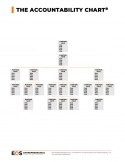
Map your structure, roles, and ownership so everyone knows who’s accountable for what.
“Let Me Process That”
I was at a Focus Day with a new team, getting ready to build the Accountability Chart, and I knew it would be tough.
You could feel the tension in the room. I didn’t know exactly what was coming, but I knew something was.
The company had two equal owners, which brought its own set of challenges.
We worked through the business’s major functions and defined the roles for each seat. One of the owners barely said a word. It didn’t become clear why until the very end.
We started going seat by seat and asking whether each person GWC’d the seat: Do they Get it, Want it, and have the Capacity to do it?
When we finished the chart, one of the owners didn’t have a seat in his own company.
Things got a little awkward.
So I asked him right there in the session: “What do you do?”
I’ll never forget his answer: “Let me process that.”
I wasn’t expecting it.
Neither was his partner, who finally let out years of frustration and said, essentially, “That’s why we’re here. You don’t do anything.”
And I remember thinking: Okay. Now we’re making progress.
The rest of the day was awkward at times, but productive.
Here’s the part that matters. By their own account, that owner had been coming into the office without a clearly defined role for about 10 years.
For 10 years, people knew there was a problem, but nobody dealt with it directly.
That tension didn’t begin when we built the Accountability Chart. It had been sitting inside the business the whole time. We simply gave the team a structure that helped them finally name it.
That conversation opened the door to change. Sometimes improving team health means being willing to enter the danger and have the conversation everybody has been avoiding.
Every Component Can Tell You Something About Team Health
Team health can sound like one of those soft, hard-to-measure ideas. But you already have six places to look.
Vision
Does everyone on the leadership team know where the business is going and how it plans to get there?
In EOS, getting everyone 100% on the same page around the eight questions in the Vision/Traction Organizer helps expose gaps in alignment. If leaders leave the room with very different ideas about the company’s future, that’s worth addressing.
People
Do your people consistently live your Core Values? Do you have the Right People in the Right Seats?
A healthy team is willing to talk honestly when the answer is no instead of avoiding the issue.
Data
Can people talk openly about the numbers?
A Scorecard isn’t much help if people are afraid to own a measurable, admit that a number is off track, or talk about why they missed it.
Healthy teams use the numbers to surface Issues and talk openly about what’s off track.
Issues
Can your team disagree?
Healthy teams can raise uncomfortable issues, challenge each other, and even challenge the owner.
That matters when you use IDS to Identify, Discuss, and Solve the real Issues in the business. You can’t solve a problem your team is afraid to talk about.
Process
Do people follow the company’s Core Processes, and can they speak up when a process isn’t working?
Documenting a process is only part of the job. The team also has to be willing to follow it consistently and address problems when reality doesn’t match what’s written down.
Traction
Does your team do what it says it’s going to do?
That means completing Rocks, following through on To-Dos, showing up prepared for Level 10 Meetings, and staying accountable to the priorities you agreed on together.
Without trust and accountability, even good plans have a way of stalling.
That’s one of the things about EOS that still amazes me. The system creates clarity around your people, your priorities, your numbers, and your problems.
And clarity makes it much harder to hide from the things holding the business back.
If You’re Thinking, “That Sounds Like My Team”
If some of this feels familiar, start by getting a clearer picture of what a healthy leadership team actually looks like.
Reading Traction by Gino Wickman is a good place to start because it explains how the pieces of EOS work together and what it takes to build a stronger leadership team.
Most owners and leadership teams I meet aren’t knowingly ignoring team health problems. A lot of them simply haven’t experienced a healthier way to operate.
If you’ve spent years in meetings where nobody challenges the owner, problems stay under the surface, or people quietly work around each other, that can start to feel normal.
It doesn’t have to be.
As EOS Implementers, part of our job is to help leadership teams become healthier, more functional, and more cohesive. A 90-Minute Meeting gives the team an introduction to EOS and helps them decide whether there’s a fit.
Healthy teams speak up, disagree when they need to, say what needs to be said, challenge the owner when appropriate, live their Core Values, hold one another accountable, and work through problems without making them personal.
How long does it take to get there? That depends on where the team starts.
Some teams need to work through years of avoided conversations. Others already have a solid foundation and just need more discipline and consistency.
My goal for every team I work with is simple: move team health one tick higher every time we meet.
Sometimes that means a major breakthrough.
Sometimes it means getting a little more honest, a little more accountable, or a little better at working together every quarter.
Either way, the result touches every part of the business.
Because the Six Key Components are all connected. And in my experience, stronger team health helps each of them work better.
Build a Healthier Leadership Team
If you want to see how EOS can help your leadership team get more aligned, solve issues more openly, and build a healthier way of working together, schedule a 90-Minute Meeting. You’ll get an introduction to EOS, a clear look at how the process works, and a chance to see whether it could help your team run the business with more clarity, accountability, and confidence.
Ready to implement EOS?
An EOS Implementer helps your team install the full system and execute it with confidence.