

Your team may not be accountable because ownership, authority, and measurement are not clearly defined. Before assuming you have a People problem, check whether each important result has one clear owner, a clear seat, and a visible way to track progress.
Accountability usually becomes visible when something important doesn’t happen the way everyone expected. A deadline slips, a decision sits too long, or a manager realizes they’re following up on work they thought had already been handed off.
At that point, the employee may be part of the problem. But there’s another piece worth checking first: Was ownership actually defined well enough for that person to succeed?
A person has a much better chance of owning their work when the result is theirs to own, their seat is clear, and there’s a concrete way to see whether they’re on track. If any of those pieces are missing, the accountability problem may be bigger than the person themselves.
1. Start With One Clear Owner
Accountability gets muddy when several people are involved in the work yet nobody is clearly responsible for the final result. A project can absolutely require input from multiple people, but the team should still be able to point to who ultimately owns the outcome.
The EOS Accountability Chart helps define that structure by mapping out the seats the business needs, the major roles for each seat, and the person accountable for each.
Contribution and accountability are different. A few people may contribute to a department, process, or project, but only one person can say, “This sits with me.”
When that ownership is defined up front, the rest of the team knows who leads the work and who supports it. When it isn’t, responsibility can get sorted out only after something goes wrong, which is usually too late.
If your team regularly asks, “Who owns this?” during a problem-solving conversation, there may be an opportunity to tighten the structure before the next Issue arises.
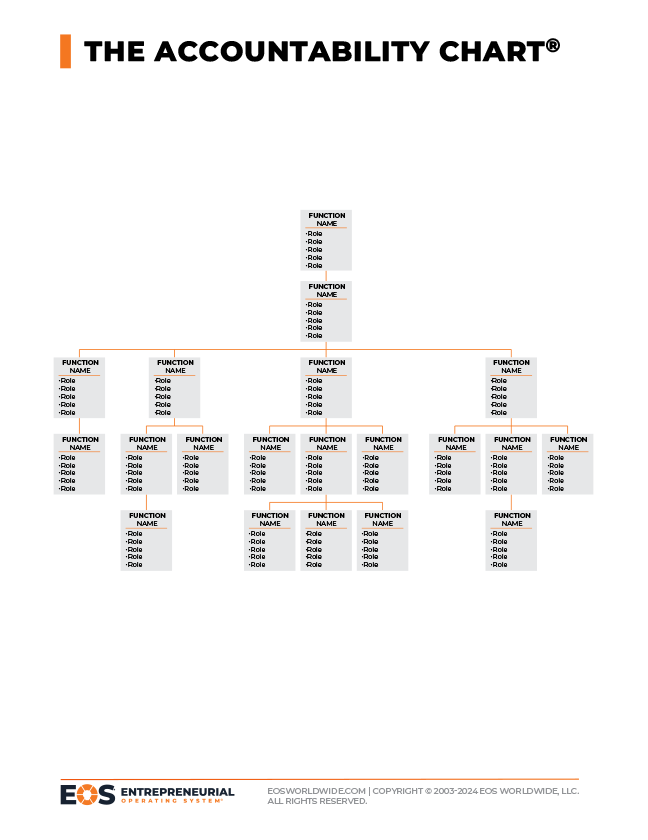
Map your structure, roles, and ownership so everyone knows who’s accountable for what.
2. Define the Result, Not Just the Activity
Another gap appears when a leader assigns a task but expects the employee to own a broader business result.
Sending a sales pipeline report every Monday is a task. Keeping pipeline information accurate enough for the leadership team to make good sales decisions is a responsibility.
The same idea applies across the business. Scheduling customer meetings, updating a system, reviewing invoices, or preparing a report might all be necessary work, but each activity usually sits inside something larger that the person is responsible for maintaining or improving.
Take another look at our guidance on Scorecards, Measurables, and accountability. The Accountability Chart defines what someone owns, and Measurables help the team see whether the responsibility is producing the result the business needs.
If an employee completes the work you assigned and you still feel like they aren’t taking ownership, revisit the handoff. The activity could have been clear, while the actual outcome was just implied.
Explaining the result gives the person a better basis for making decisions when the work changes, because they’re working toward a defined result instead of simply following the original instructions.
3. Match the Responsibility with Enough Authority
Ownership becomes fuzzy when someone is responsible for an outcome but has limited ability to influence it.
This can happen when a seat has been delegated, but many decisions related to that seat still require approval.
The employee may fully grasp the responsibility yet hesitate to follow through because experience has taught them that the final call lies elsewhere.
If you want someone to really own a result, start with The Accountability Chart. Clarify the seat, the five major roles, and what that person is accountable for. Then make sure the leader is truly letting go of work that belongs in that seat.
The boundaries can be narrow or broad depending on the role, but both people have to agree on where those limits sit.
A useful exercise is to:
- Define which decisions belong to the employee
- Define which require input
- Define which still require final approval from the leader
That gives the person room to act without leaving either side guessing about the limits.
When almost every meaningful decision still comes back to the manager, the employee may be carrying a lot of work without carrying much true ownership. That can become an Issue to IDS in the Level 10 Meeting, especially when the seat is clear on paper but not yet clear in practice.
4. Give the Team a Shared Way to See Progress
Even when ownership is well defined, accountability becomes harder if the manager and employee don’t have a consistent way to see whether the work is on track.
Without that visibility, managers have to ask for updates manually. Over time, the follow-up itself can become the way the business keeps work moving, which is frustrating for the manager and restrictive for the employee.
EOS Tools like the Scorecard, Rocks, To-Dos, and the Level 10 Meeting are designed to make commitments and results visible through the Meeting Pulse. The Accountability Chart defines who owns what, and the tools give the team a shared place to see whether things are working.
For any important responsibility, both sides should know how progress will be evaluated and where it will be reviewed. That could be a Measurable, a Rock, a deadline, or another agreed-upon result.
Once that information is visible, the manager doesn’t have to create accountability through repeated check-ins or micromanagement, and the employee doesn’t have to guess whether the work is meeting expectations.
5. Look at What’s Behind the Micromanagement
Micromanagement can absolutely be a leadership habit, but it can also point to a missing piece in the way accountability is set up.
A manager could be hovering too close to the work because they don’t have another dependable way to see progress. They step into decisions because the seat’s boundaries were never fully defined. They ask for updates because commitments aren’t being reviewed anywhere else.
In those situations, telling the manager to back off doesn’t solve much. It’s more useful to dig into what they think they would miss out on by stepping away.
Figuring out what’s driving the extra oversight helps point to the right fix, whether that means better visibility into progress, a more clearly defined seat, or more explicit decision-making authority.
In EOS terms, the leadership team can clarify the seat on The Accountability Chart, assign the right Measurables on the Scorecard, review commitments in the Level 10 Meeting, and IDS what is off track.
Now managers have a stronger reason to step back, and employees have a fair chance to show whether they can truly own the work.
If the structure is solid and the person still isn’t delivering, the leadership team can look more closely at the People side of the Issue. The People Analyzer can help determine whether the team member is the Right Person in the Right Seat.
Check the Setup Before You Decide It’s a People Problem
Employees still have a responsibility to follow through on their commitments. A well-defined seat and a good accountability structure don’t excuse missed work or poor performance.
What they do give the leadership team is a fair way to separate a foundational problem from a People problem. When expectations and decision-making authority have been established, progress is visible, and the employee has had a real opportunity to own the work, repeated misses mean something different.
At that point, you can address the person or the seat without wondering whether the company itself contributed to the problem. And if the Issue improves once the structure changes, you’ve solved the right problem without putting unnecessary pressure on the employee.
If accountability Issues keep surfacing in different parts of the company, schedule a free 90-Minute Meeting to learn how EOS strengthens the Six Key Components and helps you get more of what you want from your business.
Ready to implement EOS?
An EOS Implementer helps your team install the full system and execute it with confidence.
Frequently Asked Questions
Why is my team not accountable?
Your team may not be accountable because ownership, expectations, authority, or measurement haven’t been defined well enough. Before assuming the Issue is motivation, make sure each important result has one owner who knows what they’re responsible for and how the outcome will be reviewed.
Why don’t employees take ownership of their work?
Employees may not take ownership of their work when they’re given activities without understanding the larger responsibility, the expected result, or how the work connects to the company’s Vision, Rocks, or Measurables. They can also struggle when they’re held responsible for results, while most decisions still belong to their manager. Defining the outcome and the employee’s decision-making authority gives them a much stronger basis for owning the work.
How do you build accountability in a business?
You build accountability in a business by defining what each seat owns, naming one person accountable for each important result, and creating a consistent way to measure results and review commitments. In an EOS-run company, the Accountability Chart, Scorecard, Rocks, To-Dos, and Level 10 Meeting help connect ownership with regular visibility into performance.
What’s the difference between accountability and micromanagement?
The difference between accountability and micromanagement is that accountability gives an employee a defined responsibility, appropriate authority, and an agreed-upon method for evaluating the outcome. Micromanagement keeps the manager closely involved in the employee’s day-to-day execution to the point of obstructing productivity or employee growth. When ownership and measurement are well-defined, managers can stay informed without needing to be involved in every part of the work.