


What is an EOS® Scorecard?
The EOS Scorecard™ is a weekly report that tracks five to fifteen of the most important numbers in your business. Each number has a single owner, a weekly goal, and thirteen weeks of history visible at a glance. The Scorecard gives the leadership team an absolute pulse on the business and surfaces problems before they become crises. EOS calls these activity-based numbers: weekly numbers that predict the P&L rather than report on it.
The Scorecard is one of the simplest and most powerful tools in EOS. It cuts through feelings, opinions, and egos. Numbers do not lie.
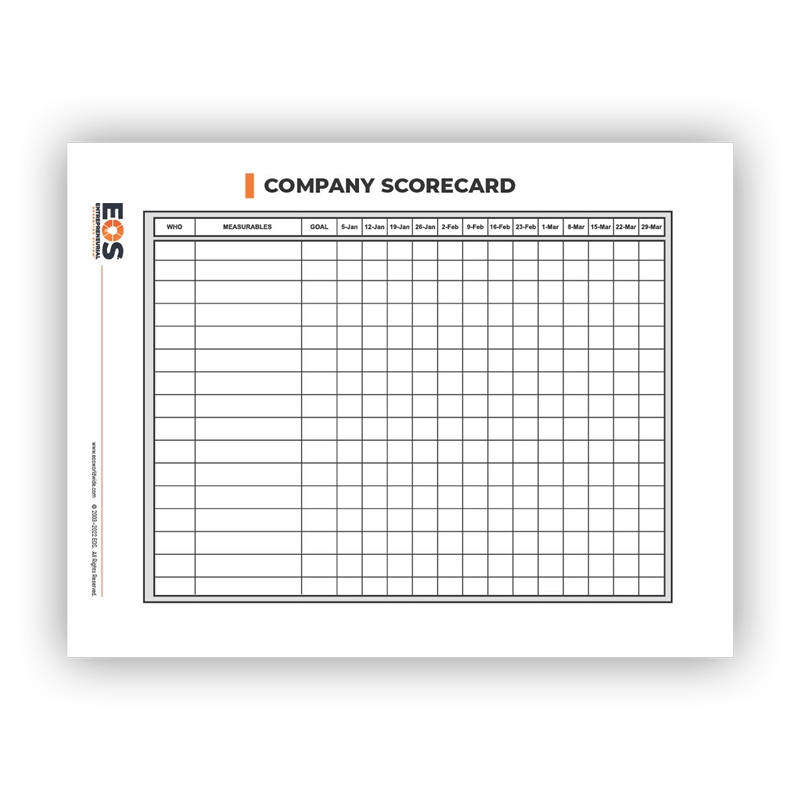
A simple weekly tool to track your most important numbers, spot issues early, and keep your team accountable.
Why the Scorecard exists
Most leadership teams rely on monthly financial statements to understand how the business is performing. By the time a monthly number shows up, the problem is 30 days old. You are reacting instead of managing.
The Scorecard fixes this by tracking weekly leading indicators. Sales activity. Service delivery. Cash position. Customer satisfaction. Hiring pipeline. The numbers that predict the monthly results.
When you see a leading indicator trend off-track in week two, you can solve it by week three. When you only see the monthly trailing number, the damage is already done.
What makes a Scorecard work
A good Scorecard has five characteristics:
- Five to fifteen numbers. Fewer than five and you are missing important signals. More than fifteen and the team drowns.
- Activity-based numbers, not P&L-style. Sales calls made, not revenue closed. Cash on hand, not profit. Deliveries shipped on time, not customer complaints. Activity-based numbers predict your P&L.
- One owner per number. Every number has one name next to it. Multiple owners means no owner.
- Weekly, not monthly. The whole point is the weekly pulse.
- Red or green at a glance. Above goal or below goal. Clear visibility every Monday morning.
Building a Scorecard
Step 1: Identify the right numbers
For each seat on the Accountability Chart™, ask: what one weekly number tells us whether this seat is performing?
Sales seat: weekly revenue closed, or weekly qualified pipeline added. Operations seat: weekly on-time delivery rate, or weekly units produced. Finance seat: weekly cash position, or weekly A/R over 60 days. Visionary™ seat: typically does not have a weekly number, but may track strategic relationships or new opportunities.
The leadership Scorecard is the sum of the top-level seat numbers.
Step 2: Set the weekly goal for each number
Each number needs a target. The target should be ambitious but achievable. When the actual is at or above goal, the cell is green. When below goal, the cell is red.
Step 3: Assign one owner per number
The owner is the person who reports the number every week. They are accountable for the result. If the number goes red, they drop it to the Issues List.
Step 4: Build the Scorecard in a simple spreadsheet
The Scorecard is thirteen weeks across, five to fifteen numbers down. Goal column on the left. Current week on the right. Red and green cells show at a glance where the business is on track.
Step 5: Review it every Level 10 Meeting
The Scorecard review takes five minutes. Each owner reports their number as on-track or off-track. No discussion. Red numbers drop to the Issues List.
Activity-based numbers (leading indicators)
EOS calls the right Scorecard numbers activity-based numbers. They are the weekly measures of activity that predict your P&L, not the P&L itself.
This is the most common mistake in building a Scorecard.
Activity-based numbers tell you what will happen: sales calls made, demos delivered, onboarding completions, cash on hand. You can influence an activity-based number this week.
P&L-style numbers tell you what already happened: monthly revenue, monthly profit, customer churn. By the time they show up, the damage is 30 days old.
A weak Scorecard is full of P&L-style numbers. A strong Scorecard is full of activity-based numbers.
Example pairs:
Departmental Scorecards
The leadership Scorecard is the top of the pyramid. Every department below leadership has its own Scorecard, cascaded down. The sales team has a Scorecard. The operations team has a Scorecard. The finance team has a Scorecard.
Each departmental Scorecard measures the numbers that roll up to the leadership Scorecard.
Common Scorecard mistakes
- Too many numbers. Fifteen is the ceiling. If you cannot see a trend in five seconds, the Scorecard is too busy.
- P&L-style numbers only. A Scorecard of lagging P&L numbers is a rearview mirror. Build it with activity-based numbers.
- Vague numbers. “Sales activity” is not a number. “Qualified demos booked per week” is.
- No owner. Every number needs one name. Assign it.
- Ignoring red cells. A red cell that does not go to the Issues List is a wasted signal.
- Changing numbers every month. A good Scorecard settles. The numbers stay the same for quarters at a time. Changing the Scorecard often means the team has not agreed on what matters.
How the Scorecard connects to the rest of EOS
- V/TO™. The 1-Year Plan and 3-Year Picture define revenue and profit targets. The Scorecard tracks weekly progress against them.
- Rocks™. Rocks get reviewed separately, but the Scorecard measures the ongoing weekly work.
- Level 10 Meeting™. The Scorecard gets reviewed every week in the Scorecard section.
- Issues List. Red numbers drop to the Issues List for IDS™.
- Accountability Chart. Every major seat has a number on the Scorecard.
Frequently Asked Questions
How many numbers should be on a Scorecard?
Five to fifteen. Closer to fifteen for larger leadership teams. Closer to five for smaller companies.
What is the difference between a Scorecard and a dashboard?
A dashboard typically shows many numbers, often lagging indicators, updated in real time. A Scorecard shows five to fifteen leading indicators, one owner per number, reviewed weekly by the leadership team. The Scorecard is simpler, more disciplined, and more actionable.
Should the Scorecard include financials?
Yes, at least one or two. Cash on hand and weekly revenue are common leadership Scorecard numbers. But financials should not dominate. Leading operational indicators often matter more week to week.
Who updates the Scorecard?
Each owner updates their own number before the Level 10 Meeting. One person on the leadership team typically owns the Scorecard file itself.
Is the EOS Scorecard trademarked?
Yes. The EOS Scorecard is a trademark of EOS Worldwide.
What happens when a number is red?
It drops to the Issues List for IDS during the Level 10 Meeting. The team identifies the root cause, discusses the fix, and solves it.
Related EOS Tools
Start Using a Scorecard in Your Business
Ready to manage by numbers instead of opinions? Start with a Free 90-Minute Meeting with a Professional EOS Implementer.
Ready to Lead With the Numbers?
An EOS Implementer can help your leadership team build the right Scorecard, track meaningful numbers, and solve issues before they become bigger problems.
Written by EOS Worldwide
Reviewed by Mark O'Donnell, Visionary & CEO, EOS Worldwide
EOS Worldwide is the organization behind the Entrepreneurial Operating System®. Content reflects official EOS® doctrine.