One simple Scorecard can turn sleepless nights into steady, profitable growth.
The Night the Numbers Finally Spoke
Mike, the owner of a $12 million HVAC company, paced his kitchen at 2:07 a.m. Payroll was due Friday, and the bank balance sat precariously low again.
Revenue looked solid on paper, yet cash kept disappearing like socks in a dryer. His leadership team felt successful; they just couldn’t prove it, predict it, or rely on it.
At their next Level 10 Meeting®, the team made a radical decision. They shut the laptop filled with 42 spreadsheet tabs and committed to a single-page Scorecard with 13 weekly numbers.
Within one quarter, they knew every Monday by 10 a.m. whether marketing, sales, operations, or finance was drifting off course. Fourteen days of early warning gave them time to act, patch the leak, and sleep through the night.
That turnaround isn’t magic. It’s what happens when entrepreneurial leaders replace gut feelings with the right data and then use it to address the frustrations that keep many 10- to 250-person companies stuck.
Meet the Five Entrepreneurial Frustrations
More than two decades of EOS® Sessions reveal the same patterns of pain. We call them the Five Entrepreneurial Frustrations:
- Lack of control: The business seems to run you instead of the other way around.
- People problems: Team members, vendors, or customers fail to row in the same direction.
- Profit shortfalls: Cash never quite matches the effort you pour in.
- Hitting the Ceiling: Growth stalls, and the next level feels unreachable.
- “Nothing’s working” exhaustion: New ideas flame out like last month’s fad.
When EOS surveyed clients about why they hired an EOS Implementer®, 82% pointed directly to People problems, followed by Control, Profit, and the rest of the list.
The good news? Strengthening the Data Component gives leaders the objective information needed to address these frustrations.
Running a company without data is like driving through a sleet storm with broken windshield wipers. Anxiety rises, decisions slow, and the talent in your passenger seat starts questioning whether the driver has a plan.
EOS Implementer Randy McDougal calls it “living under uncertain terror.” Data wipes the windshield, restoring visibility and confidence.
Build a Weekly Scorecard
The EOS Scorecard lives on one page and contains 5 to 15 weekly activity-based Measurables that help predict results.
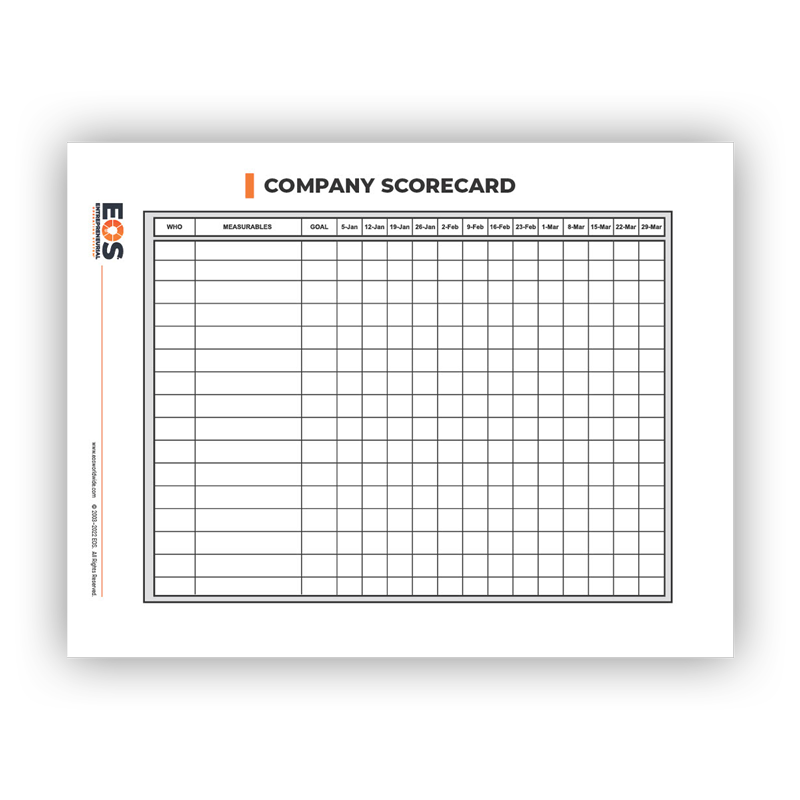
Download the free Scorecard template to identify your most important weekly Measurables, assign clear owners, and spot problems before they affect your results.
Fewer than five numbers may leave blind spots. More than 15 can invite analysis paralysis.
Why weekly? A seven-day cadence lets you steer before reaching the ditch. Monthly financial statements lag behind reality by 30 days. By then, the wheel may have already left the pavement.
Build your Scorecard in three deliberate steps:
| Step | What to Do | Practical Example |
|---|---|---|
| 1. Identify 5–15 activity-based Measurables. | Think “quotes sent,” not “revenue booked.” | The HVAC team selected inbound service calls, estimates delivered, installations completed, average ticket, and cash collected. |
| 2. Assign exactly one owner to each number. | Accountability requires clarity. | The service operations manager owns “installations completed,” while the controller owns “cash collected.” |
| 3. Set a weekly goal that acts like a rumble strip. | On track or off track. Avoid an ambiguous middle ground. | “Installations ≥ 24” keeps crews productive without overloading them. |
Pro tip: Pick numbers you can influence this week, not numbers you can only admire next month.
Pressure-Test Every Measurable
Before finalizing your Scorecard, challenge each number with these questions:
- Does it measure activity rather than only an outcome?
- Is it simple to pull without a Ph.D. in pivot tables?
- Does it genuinely help predict the result we care about?
- Will hitting the goal 80% of the time feel like success?
- Is the desired trend obvious: up, down, or steady?
- Will it trigger action when it goes off track?
If a Measurable fails even one question, refine or replace it.
Turn Lagging Data Into Leading Clarity
Picture three dials on your dashboard: Activity → Result → Cash.
Most owners stare at the third dial and wonder why the second one won’t move. Leading indicators give you time to correct course before lagging results appear.
| Lagging Result | Leading Indicator | Goal | Action When Off Track |
|---|---|---|---|
| Bank balance | Invoices collected | ≥ $125,000 per week | The controller calls overdue accounts by Tuesday. |
| Installation revenue | Projects scheduled | ≥ 24 jobs | The service manager adds overtime or schedules a subcontractor. |
| Net Promoter Score | Same-day support responses | ≥ 95% | The operations team uses IDS to solve the bottleneck. |
A number that is off track is never a reprimand. It’s a neon arrow pointing toward an Issue your team gets to solve.
Give Everyone a Number
Leaders often stop after building a top-level Scorecard. Don’t.
The real breakthroughs happen when departments create their own five-number Scorecards and every seat on the Accountability Chart owns at least one Measurable.
A front-desk receptionist might track “inbound calls answered within three rings.” A warehouse picker may own “order errors ≤ two per week.”
When numbers replace assumptions, teams gain greater clarity, receive quicker coaching, solve problems together, and understand how their daily actions support company goals.
Review the Scorecard Every Week
One person must own the discipline of completing the weekly Scorecard. When any number is off track, drop it onto the Issues List during the same Level 10 Meeting® and use IDS:
- Identify the root cause.
- Discuss the issue candidly without side stories.
- Solve it with a To-Do due the following week.
Fast cycles keep small stumbles from snowballing into quarter-ending crises.
Real-World Results at College City Beverage
Before EOS, this Minnesota distributor met about financials “once a quarter, and most people weren’t really understanding them too deeply,” recalls General Manager Ben Chell.
Today, the company runs five departmental Scorecards plus a senior leadership Scorecard. Conversations that once began with “We need more people” now start with facts.
If overtime hours are within the target, the request disappears. If they spike, leaders see it immediately and act.
CFO Dave Shonka says his role shifted from “lonely numbers guy” to coach of a company fluent in data. Profits rose, resources went where they mattered, and trust increased because transparency removed guesswork.
Numbers, he says, “tell a story everyone understands.”
Your Seven-Day Sprint to Clarity
- Draft a Scorecard with no more than 15 weekly activity-based Measurables.
- Assign an owner and a weekly goal to each number.
- Review it next week during the five-minute Scorecard section of your Level 10 Meeting.
- Cascade one level by selecting one department and repeating the first three steps.
- Circle the first number that is off track and use IDS to determine the root cause.
- Document the To-Do with a one-week deadline.
- Celebrate the win when the number returns to its goal, then adjust stale Measurables as needed.
When every seat in your organization owns a clear weekly number, the Five Entrepreneurial Frustrations begin to lose their grip.
Control returns, People row together, problems become visible earlier, and leaders gain the confidence to make better decisions.
Ready to Lead With the Numbers?
An EOS Implementer can help your leadership team build the right Scorecard, create greater accountability, and use weekly data to solve issues before they grow.