Growth has a way of exposing things that were much easier to live with when the business was smaller. Here’s how teams spot outdated processes, systems, and structures before the quick fixes that fueled early growth start blocking what comes next.
The systems, habits, and structure that helped you get here might still be doing their jobs, but that doesn’t mean they’re still serving the business well. Eventually, extra steps creep in, leaders get pulled into decisions they shouldn’t own, and people start compensating for processes that just don’t fit.
That can be a frustrating place for a leadership team because nothing is necessarily broken enough to demand immediate attention.
The business is still running, and people are still getting the work done. It just takes more effort now than it should.
That’s a big sign that the business has hit a ceiling.
Breaking through the ceiling requires leaders to strengthen five leadership abilities: Simplify, Delegate, Predict, Systemize, and Structure. One place to start is by looking closely at the systems, processes, and structure that may no longer fit where the business is going.
1. Pay Attention to the Workarounds Everyone Has Learned to Live With
Maybe the software doesn’t quite handle something, so someone builds a spreadsheet that never gets updated after its first use. Then a regular report requires pulling in data from three different places. Or two departments manually enter and exchange the same information separately because their systems don’t talk to each other.
At first, these fixes can be resourceful. The team finds a way to keep going without having to stop everything to completely rebuild a process.
The problem comes when the workaround stops being temporary.
Over time, people forget why the extra steps exist. New employees are trained to follow them. Leaders assume the process is complicated because the work itself is complicated, when some of that complexity was added piece by piece over the years.
If people regularly say things like, “That’s just how we do it,” pay attention.
Find the places where the team is doing extra work to compensate for a tool, system, or process that no longer fits.
You may find that the team doesn’t need another workaround. It needs to simplify and systemize the work that’s already there.
2. Check Whether Your Structure Still Matches the Business
The organizational structure that got you through one stage of growth may not be the structure you need for the next one.
Early in a company’s life, people naturally wear several hats. Leaders stay involved in a wide range of decisions because the team is small, roles overlap, and the business needs everyone to pitch in wherever they can.
But after that stage of accelerated growth, if decisions still funnel through the founder, department responsibilities overlap, or nobody is completely sure where one leader’s role ends and another begins, the company can start creating its own bottlenecks.
The EOS Accountability Chart helps leadership teams step back from the people currently in the business and look at the structure itself.
Instead of starting with the people you have and trying to divide the work around them, look at “structure first, people second.” What are the major functions? What seats are needed to own those functions? What are the five major roles inside each seat?
Then ask whether you have the Right Person in the Right Seat.
A structure that worked two years ago doesn’t have to stay untouched simply because it once worked well. Build around what the business needs now and where it’s headed next.
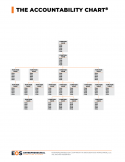
Map your structure, roles, and ownership so everyone knows who’s accountable for what.
3. Make Sure Your Core Values Still Show Up in Real Decisions
Core Values can also get diluted as a company grows.
When a team is small, culture spreads through proximity. Employees spend time with the founder and other leaders, hear how they think, and pick up on what’s encouraged or discouraged.
Once the company gets bigger, you can’t rely on osmosis to instill culture.
Core Values have to become part of how the business actually operates. They should influence who gets hired, how people are coached, which behaviors are rewarded, and whether someone belongs in the organization long term.
As the company grows, the question isn’t whether your Core Values should change to match the next stage of growth. The question is whether the organization consistently lives the Core Values it has identified.
Pay attention to whether leaders are using them in real decisions and whether your people understand what living them looks like.
Your Core Values should give people a common language for how the company operates. If they require a long explanation or rarely come up outside an annual meeting, there’s probably more work to do bringing them to life.
4. Don’t Confuse More People or More Tech with a Better System
When the business starts feeling strained, adding something can seem like the obvious answer.
Another hire or another piece of software can feel productive because something is changing. But adding another layer doesn’t automatically fix what’s underneath it.
Before adding anything, identify the real Issue.
If the root problem is unclear ownership, another platform won’t solve it. If the process itself is bloated, adding another person may only give someone else more unnecessary steps to manage.
AI has made this question even more relevant. Leaders are constantly presented with new tools, applications, and possibilities, and it can be tempting to start experimenting everywhere at once.
Experimentation can be valuable. Just make sure it starts with a real Issue. Use IDS to Identify what’s actually getting in the way, Discuss what’s underneath it, and Solve it at the root. Then decide whether technology is part of the solution.
Otherwise, the business can end up collecting solutions without fixing the original problem.
5. Look at What Your Growth Goal Actually Requires
A long-term goal is useful because it gives the leadership team somewhere specific to go.
The next question is harder: What has to be true for us to get there?
A bigger goal puts pressure on the way the company already operates. It forces the leadership team to ask whether the current business can actually support the business they’re trying to build.
That could expose a need for stronger leadership capacity, better systems, or a structure that can carry more without piling additional decisions onto the same people.
The Vision/Traction Organizer helps leadership teams put that longer-term picture in one place and connect it with what needs to happen in the shorter term.
A future goal is to help the team make better decisions now, not just give everyone a destination to talk about.
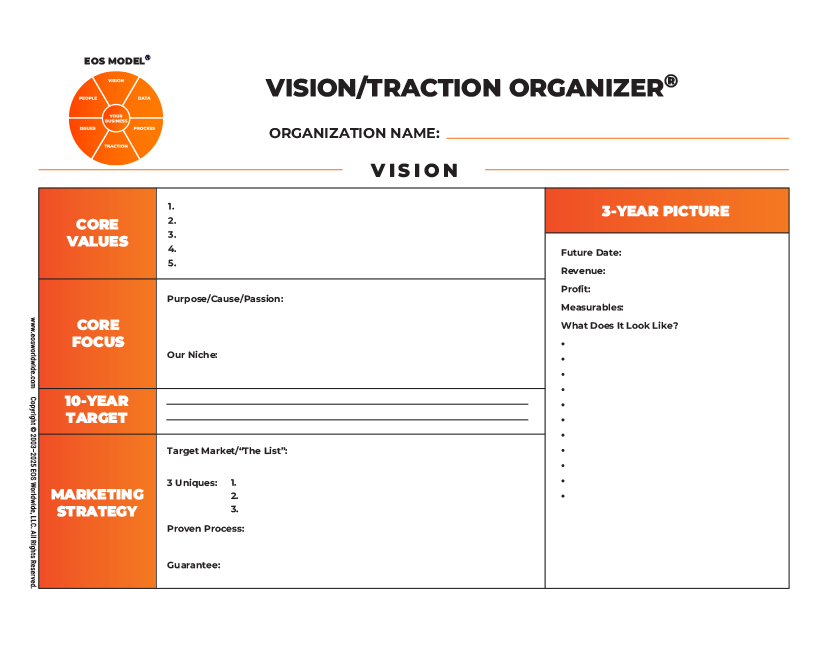
Turn scattered ideas into one clear vision your team can follow.
6. Give Your Leadership Team Time to Reconsider Old Answers
Some of the hardest things to change in a growing company are the things that are still technically working.
A process can still function and still be taking too much effort. A role can still exist even though the work inside it has changed. A meeting can still happen every week without helping the team solve much of anything.
Because nothing has completely broken, those things keep getting pushed aside.
The EOS 90-Day World creates a regular quarterly discipline for the leadership team to step out of the day-to-day, review the V/TO, review the previous quarter’s Rocks, establish the next quarter’s Rocks, and resolve key Issues.
That quarterly discipline gives the team a regular opportunity to look at what has changed, what’s working, what isn’t, and what the company needs next.
Sometimes that confirms an old decision still makes sense. Other times, it exposes something the team has been working around for months.
Regularly revisiting those decisions keeps “technically working” from becoming the standard for how the business operates.
A Growing Business Shouldn’t Run Exactly Like a Smaller One
Episode 22 of Hitting the Ceiling, featuring Cory Bengtzen and Tommy Aoki of SkyShare, offers a clear example of how quickly a useful system can become a limitation.
The leaders of private aviation company SkyShare discussed reaching the limits of systems they had used successfully for years. Their flight management platform had once supported the size of the fleet well, but as the business grew beyond that range, repetition, double entry, and other pain points became much harder to ignore. The answer wasn’t that the original system had always been bad. The company had simply grown beyond what it was built to handle.
Something doesn’t have to be a bad system to be the wrong system for your business now.
Your processes, structure, technology, leadership roles, and meeting habits shouldn’t get a permanent pass just because they worked before.
If your leadership team keeps running into the same bottlenecks, take those to IDS. Identify the root Issue, Discuss it openly and honestly, and Solve it for the greater good of the organization. Solve it at the root instead of building another workaround around it.
You don’t need to rebuild the company every time you grow. You do need to notice when yesterday’s fixes are creating today’s extra work.
Listen to the full SkyShare episode of Hitting the Ceiling.
For more practical insights to help you strengthen your business and get what you want from it, subscribe to the Clarity Break Thoughts newsletter.
Frequently Asked Questions About Outgrowing Your Business Systems
How do you know when a business has outgrown its systems?
A system may be reaching its limit when the team has to put increasing effort into keeping it functional. Common signs include duplicate work, frequent manual workarounds, information living in several places, recurring bottlenecks, and employees spending more time maintaining a process than the work seems to require.
What should a leadership team review as the company grows?
Look at whether the way the company operates still supports its goals. Structure, processes, technology, Core Values, and leadership capacity all need to hold up as the business gets larger and more complex.
How does EOS help a company break through a growth ceiling?
EOS helps leadership teams strengthen the Six Key Components of the business using simple, practical tools and disciplines. When a company hits the ceiling, leaders also strengthen the Five Leadership Abilities: Simplify, Delegate, Predict, Systemize, and Structure.
Should you replace a process as soon as it becomes inefficient?
Not necessarily. First, identify why the process is creating problems. Replacing the system won’t help much if the real Issue is ownership, unnecessary complexity, or a seat that no longer matches the work. IDS helps the team get to the root before deciding what needs to change.