

The cost of business inefficiency is the time and money lost to recurring problems that should be solved at the source rather than repeatedly worked around.
Business inefficiency can be easy to overlook because it often hides inside the way work gets done. Your team handles problems as they arise, and over time, the extra effort required to keep things moving starts to feel like a normal part of running the company.
That changes as the business grows. A workaround that was manageable on a smaller scale becomes more costly as volume increases, putting pressure on margins even as revenue grows.
Understanding where that pressure comes from is the first step toward fixing it.
Where Does the Cost of Business Inefficiency Show Up?
The cost of business inefficiency shows up most clearly in the extra time your company spends getting work across the finish line. The source of that extra effort will look different from one business to another, but there are a few places where the cost is easier to see.
Poor Leadership Team Alignment
Poor leadership team alignment becomes expensive when employees can’t confidently act on the direction they’ve been given.
Consider a company where sales is pushing for faster delivery while operations is under pressure to control overtime. Without agreement at the leadership level on how to balance those priorities, the people doing the work have to resolve the same conflict each time it reaches them.
So, what looks like a day-to-day execution problem may actually begin with the leadership team. Until the priority is clear, the business keeps spending time resolving a question that should already have an answer.
Rework
Rework creates a more visible cost because the company pays for time that wouldn’t have been necessary if your team had completed the work correctly the first time.
A mistake that takes 15 minutes to correct may not deserve much attention on its own. When the same mistake keeps happening, however, the accumulated time begins to consume the capacity your team could have applied elsewhere.
The useful question isn’t whether mistakes happen. They will. What matters is whether your team keeps paying for the same preventable mistake.
Owner Dependence
Owner dependence costs the business when routine work stalls because others lack sufficient clarity or authority to move forward.
The issue isn’t simply that the owner is busy. It’s that the business requires the owner to keep everyday work moving when that work could otherwise continue without their involvement.
As the company grows, this dependence becomes increasingly difficult to sustain. More activity reaches the same bottleneck, and the owner has less capacity to focus on leading the business forward.
Growth makes these inefficiencies more expensive because higher volume magnifies problems that once seemed small.
Why Does Business Growth Sometimes Hurt Margins?
Business growth sometimes hurts margins because inefficiency can cause the cost of delivering additional work to rise faster than the revenue it produces.
Imagine a service business where jobs routinely reach the field without all the information needed to complete them. At a lower volume, the team may be able to resolve those gaps without much disruption, so the weakness in the handoff remains easy to tolerate.
Growth changes the economics. As the number of jobs increases, the company spends more paid time resolving the same problem. Eventually, additional labor may be needed to handle a workload that would require less effort if the handoff worked properly.
The company has more business, yet the cost of working around an inefficient operation offsets the benefit.
That’s why adding people isn’t always the first answer to a capacity problem. Before increasing resources, find out how much unnecessary work is eating up existing capacity.
How Do You Measure the Cost of Business Inefficiency?
You measure the cost of business inefficiency by identifying a recurring problem and calculating how much paid time it takes to deal with it.
Rework is often a practical place to begin because the activity is visible enough to track. Suppose 10 employees each spend two hours per week correcting the same type of preventable problem, with an average employment cost of $50 per hour:
10 employees × 2 hours × $50 = $1,000 per week
Across 48 working weeks, the company is spending $48,000 in paid time on that rework.
The calculation doesn’t mean eliminating the problem will put $48,000 back in your bank account. Payroll may stay the same. What it shows is how much paid capacity is being consumed by a preventable problem.
That gives the leadership team a much stronger starting point than a general sense that the company needs to become more efficient. You know where some of the capacity is going, which means you can investigate why you’re losing it.
How Do You Reduce Business Inefficiency?
To reduce business inefficiency, solve the real issue at the root so your team stops repeatedly working around it.
Suppose the rework you measured traces back to incomplete information moving from one department to another. The immediate response is to gather the missing information so the current job can continue, while the lasting response is to improve what happens before the handoff.
That difference matters because efficiency isn’t simply about completing work faster. A business becomes more efficient when the work itself requires less unnecessary intervention.
Once you address the cause, give the team a simple way to know whether the change is working. For the handoff problem, a weekly metric could show how often the receiving team gets everything it needs the first time. If performance improves while rework falls, the business has evidence that it solved more than the symptom.
One problem may be all you need to address. When similar breakdowns continue appearing elsewhere, however, isolated inefficiencies can begin to reveal a broader pattern of operational dysfunction.
How Does Operational Dysfunction Affect a Business?
Operational dysfunction affects a business when recurring inefficiencies are no longer isolated problems but begin to interfere with how the company operates as a whole.
This distinction is important. A single weak handoff doesn’t necessarily mean the business has a larger operational problem. When the leadership team repeatedly finds itself dealing with different versions of the same underlying friction, there may be more to address than one workflow.
At that point, fixing problems individually can only take you so far. The more useful question is whether something about how the company is running allows those problems to keep recurring.
That shift in perspective helps you decide where to focus next.
Where Should You Focus First to Reduce Operational Dysfunction?
To reduce operational dysfunction, focus first on the recurring weakness that is creating the greatest drag on the business.
You don’t need to redesign the entire company to begin. Use what you’ve already learned about the inefficiencies affecting your business and look for the common cause behind them.
Instead of continuing to work around the same problem, ask what the real Issue is and solve that. That might look like asking your leadership team:
What about the way we run this business keeps this problem from going away?
The answer may give you a clear starting point. If it doesn’t, stepping back from individual problems can help you see the company more objectively.
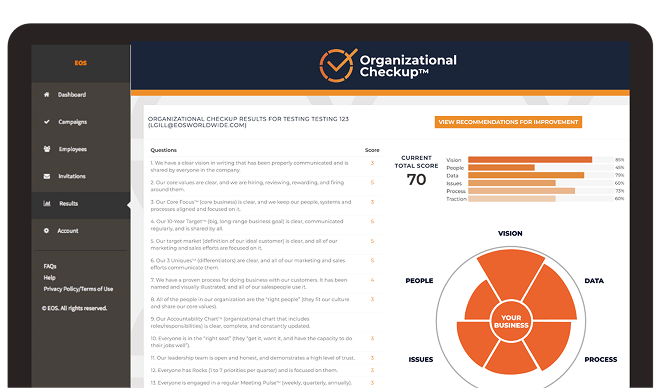
The EOS Organizational Checkup is one way to do that. It helps your leadership team measure your business’s strength across the Six Key Components and identify where the organization needs to strengthen.
For some leadership teams, that clarity is enough to make meaningful progress. But when the underlying problems remain difficult to solve, the next decision is whether a more complete approach would help.
See how strong your business really is.
Take the free Organizational Checkup to assess your strength in each of the Six Key Components.
When Should You Get Outside Help With Business Inefficiency?
Outside help may be useful for addressing business inefficiencies when your leadership team can see the inefficiencies affecting the business but struggles to implement changes that prevent the problems from recurring.
Getting outside help doesn’t discount the progress you’ve already made, either. It’s particularly helpful when you’re no longer able to address broader inefficiency across the business by solving one problem at a time.
And if you’re at that point, the Entrepreneurial Operating System (EOS) may be the answer.
EOS is a complete, proven system designed to help entrepreneurial leadership teams run their businesses more effectively. Rather than addressing a single operational symptom in isolation, EOS provides the leadership team with a practical way to strengthen the business as a whole.
If you want to understand what that would look like for your company, a 90-Minute Meeting allows your leadership team to learn how EOS works and decide whether it fits what you’re trying to accomplish.
Book a 90-Minute Meeting with an EOS Implementer to explore whether EOS is the right next step for your leadership team.
Ready to implement EOS?
An EOS Implementer helps your team install the full system and execute it with confidence.
Frequently Asked Questions
What Does Poor Leadership Team Alignment Cost a Business?
Poor leadership team alignment costs a business when employees have to spend additional time resolving direction that should already be clear. The financial impact grows when that uncertainty repeatedly slows decisions or causes your team to revisit completed work.
How Does Disorganization Affect Profitability?
Disorganization affects profitability when the company spends paid time addressing preventable problems rather than using that capacity productively. Measuring the time associated with a recurring problem can help the leadership team see how much that inefficiency is actually costing.
Why Does Growth Sometimes Hurt Margins?
Growth sometimes hurts margins because higher volume can increase the cost of inefficiencies that were easier to absorb when the company was smaller. If additional revenue also requires more time to work around recurring problems, the company may grow without seeing the margin improvement it expected.