

The signs your business needs a better system usually show up when growth starts creating more confusion instead of more control.
As your business grows, the way you used to run it often starts getting stretched. There are more people, more customers, more decisions, and more handoffs, which means there are also more opportunities for things to get missed, misunderstood, or delayed.
When the company was smaller, you could probably fill in a lot of those gaps yourself. You knew what was happening, who was doing what, and where to step in if something went wrong. As the business gets bigger, that becomes harder to do consistently.
That is usually when the symptoms start to show up: missed work, unclear accountability, recurring problems, inconsistent processes, and important priorities that keep getting pushed aside.
Here are seven signs your business may need a better system and what each one can tell you about where to focus next.
7 Signs Your Business Needs a Better System
1. You Can’t Take a Day Off Without Checking In
When routine work slows down whenever you step away, too much of the business may still depend on you.
You may be able to take the afternoon off physically, but you are still answering customer questions, approving decisions, or checking your phone because you know certain things will sit there until you get involved. A vacation can start to feel like working from a different location rather than actually stepping away.
If that sounds familiar, pay attention to the questions and approvals that keep coming back to you. As the business grows, your team needs enough clarity and accountability to handle more of the day-to-day work without waiting for you to step in.
2. You’ve Added People, but Work Still Gets Missed
Adding more people should make the business easier to run, so if the team is growing and things are still falling through the cracks, the issue may be less about headcount and more about accountability.
You may notice it when an order does not get placed, an invoice sits too long, or a customer ends up waiting for a callback because everyone assumed someone else was handling it. When phrases like “I thought they had it” or “Nobody told me” start becoming part of the normal conversation, that is usually a clue that people are not as clear as they need to be about who is accountable for the result.
The bigger the company gets, the harder it becomes to rely on assumptions. Clear accountability helps people know what they own and gives the rest of the team confidence that someone has it.
3. Sales Are Up, but the Extra Profit Isn’t There
Growth can look great on the top line while still creating frustration underneath it. Revenue may be increasing, everyone may be busier than ever, and yet the extra profit you expected does not seem to be showing up.
Often, the money is disappearing through small gaps that become more expensive as volume increases. Over time, callbacks, corrections, rush work, poor handoffs, and rework may not seem significant on their own, but together they can quietly eat into margins.
If the company is growing and everyone feels busier without the financial results you expected, look beyond the sales numbers and pay attention to where extra time, effort, and money are being spent. The problem may not be growth itself. It may be the way the business is handling that growth.
4. You’re Spending More Time Fixing Work You’ve Already Done
When the same kinds of mistakes keep showing up, it is worth looking at how the work is actually getting done rather than treating each problem as a one-off.
You may find yourself correcting invoices, sending people back out to finish jobs, or dealing with customer details that keep getting lost between teams. Sometimes the clearest sign is that two people handle the same important task in completely different ways.
A simple way to test this is to ask two people to explain how the same important process gets done. If you hear two very different answers, you may have found part of the problem. The issue is not necessarily that someone is doing poor work. It may be that the right way to do the work has never been made clear enough for everyone to follow consistently.
5. Your Meetings Keep Covering the Same Problems
A problem that comes back once is frustrating. A problem that keeps coming back after your team has already spent time discussing it is telling you something more important.
Maybe your leadership team has already talked about late jobs, the hiring issue, or the disconnect between departments, and everyone leaves the meeting agreeing that something needs to change. Then the next week comes around, and you find yourselves having essentially the same conversation again.
When that pattern continues, the problem is not that your team is avoiding the subject. It is that the discussion is not getting far enough to solve the real issue.
Look back at your recent leadership team meetings and notice how many conversations feel familiar. If the same problems keep resurfacing, your team may need a more disciplined way to get to the root, solve them, and move forward.
6. You Never Get to the Work That Would Make Things Easier
Urgent work has a way of taking over the week, especially when a company is growing. The problem comes when the urgent work repeatedly pushes aside the important work that would actually make the business easier to run.
You may have been meaning to train a manager, fix a broken handoff, improve onboarding, or document an important process, but another customer problem or staffing challenge always seems to take priority. Before long, another quarter has passed, and the same important work is still waiting.
When that happens consistently, the business can stay very busy without making enough progress on the things that would help it grow more smoothly. You need a way to decide what matters most and keep those priorities from getting buried under the day-to-day.
7. Changes Help for a While, Then Old Habits Return
Sometimes you know something needs to change, so you introduce a new meeting, create a tracker, reorganize responsibilities, or implement a new process. It helps for a while, and then, once the business gets busy again, people gradually return to the way they were doing things before.
If that keeps happening, the problem may not be the individual idea. It may be that each change is happening on its own rather than as part of a consistent way of running the business.
That is often when leaders realize they do not need another isolated fix. They need a system that connects direction, accountability, performance, problem-solving, processes, and follow-through so that these pieces reinforce one another rather than compete for attention.
Why Growth Can Reveal Gaps in Your Business System as You Scale
Growth often exposes parts of the business that worked well when the company was smaller but are no longer giving the team enough clarity or consistency.
When there are only a few people, it is easy for an owner or leader to fill the gaps. You can answer the question, catch the mistake, make the decision, remind someone about the deadline, or step in when a handoff breaks down. Because everyone is close to the work, a lot of information can live in people’s heads.
That becomes much harder as you add employees, customers, departments, decisions, and handoffs. The same informal approach that once felt fast and flexible can start creating confusion because there are simply too many moving parts for a few people to keep everything connected.
A stronger business system gives your team a shared way to understand where the company is going, who is accountable for what, how performance is measured, how problems get solved, how important work gets done, and what matters most next.
How to Overcome Business Scaling Problems
If you are dealing with business scaling problems, start by strengthening the operating basics that create clarity and consistency: direction, accountability, information, problem-solving, processes, and follow-through.
Get Clear on Where You’re Going
People make better decisions when they understand where the company is going and what matters most right now.
If different members of the leadership team give different answers about the company’s direction, priorities, or plan, that lack of clarity eventually works its way through the rest of the organization.
Make Accountability Clear
As the company grows, people need to know more than what their job title is. They need to understand what they are accountable for and where decisions belong.
When accountability is clear, people know what they own, the team knows where to go for answers, and the business relies less on a few leaders to keep everything moving.
Use a Few Numbers to Know What’s Happening
As the business gets more complicated, it becomes harder to manage based on what people think or feel is happening. A small set of useful numbers gives the leadership team a more objective view.
The point is not to measure everything that can be measured. It is to identify the few numbers that give you the clearest picture of how the business is performing.
Solve Recurring Problems at the Root
When the same problem keeps recurring, addressing the symptoms is not enough, because the team will eventually find itself dealing with the same frustration again.
Make time for your leadership team to identify what’s really happening, agree on a solution, and decide who will follow through.
Make Important Work Consistent
As a company grows, you cannot rely on everyone figuring out the work on their own. The key processes that keep the business running need to be clear enough for people to execute consistently.
Document the essential steps, keep them simple, and train people to follow them consistently.
Protect Your Most Important Priorities
Most companies do not struggle because they have no idea about what needs to improve. The harder part is protecting those priorities once the week gets busy.
Choose a small set of priorities for the next 90 days and make someone accountable for each. Review progress regularly so the important work gets finished.
See Where Your Business Needs to Get Stronger
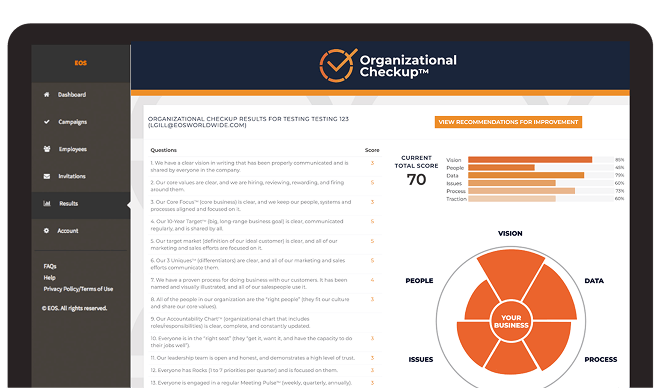
If you are seeing several of these signs and are not sure where to start, the EOS Organizational Checkup can help you look at the business more objectively.
EOS, the Entrepreneurial Operating System, is a complete, proven system with simple, practical tools that help leadership teams strengthen the Six Key Components of their business: Vision, People, Data, Issues, Process, and Traction.
The Organizational Checkup helps you assess your company’s strength across those Six Key Components so you can see where the business is strong and where more attention may be needed.
It can be a practical starting point whether you are learning about EOS, implementing EOS on your own, or considering help from an EOS Implementer.
See how strong your business really is.
Take the free Organizational Checkup to assess your strength in each of the Six Key Components.
Get More Guidance on Running a Stronger Business
If you want help understanding what a stronger operating system could look like for your company, a 90-Minute Meeting provides your leadership team with a practical next step.
Book a 90-Minute Meeting to learn how EOS works and determine whether it is a fit for your leadership team.
Ready to implement EOS?
An EOS Implementer helps your team install the full system and execute it with confidence.
Frequently Asked Questions
How Do I Know if My Business Needs More Structure?
Your business may need more structure when routine work requires constant reminders, responsibilities aren’t clear, important tasks get missed, or too many decisions depend on a few people.
These are common signs your business needs a better system, especially as the company grows. Start by clarifying who owns important results, how core work gets done, which numbers matter, and how your team will solve problems and follow through.
What Are the Signs a Business Has Outgrown Its Leadership Approach?
A business may have outgrown its leadership approach when too much still depends on the owner or a small group of leaders.
Other signs include unclear ownership, recurring problems, managers who need approval for routine decisions, and important priorities that continually lose out to urgent work.
Why Does Growth Sometimes Make a Business Harder to Run?
Growth can make a business harder to run because it adds people, customers, decisions, and handoffs faster than the company’s operating model can keep pace.
A clear business system gives people a shared way to understand priorities, make decisions, measure performance, solve problems, and get work done.