

After reading Traction, bring your leadership team together and decide how you will start implementing EOS.
The sticky notes, highlighters, and pens are down: You finished reading Gino Wickman’s Traction: Get a Grip on Your Business. Welcome to the club! Now it’s time to move from reading about EOS to running your business on EOS.
Many leaders reach this point and start searching for answers to the same questions: What do I do after reading Traction? How do I actually start using EOS? Can I implement EOS on my own?
Reading Traction is a strong first step of an exciting and rewarding journey. But the value of the EOS Model unfolds once you begin to put the EOS Tools to use in the real world with your leadership team properly and consistently, week after week. That’s where the book moves from a great idea to a tangible way of running the business.
The First Step After Reading Traction
After reading Traction, everyone on your leadership team needs to commit to running the business on EOS. That means leadership is willing to learn the EOS Tools, use the same language, be open and honest, and commit to a Meeting Pulse.
EOS works through the leadership team first, so the people in that room need to be ready to work on the business, not simply talk about it.
This is where many teams make the mistake of grabbing the EOS Tool that feels most urgent and running with it. One leader wants to build the Vision/Traction Organizer (V/TO), another wants a Scorecard set up by Friday, and someone else wants to map out the Accountability Chart.
Those resources are all important, but they work best when used in the right order as part of the EOS Process. The EOS Process exists to help leadership teams master the right EOS Tools at the right time and in the right order.
Once everyone is informed with the basic intention and proven history of EOS, you need to decide your implementation path. You have two real options: hire an EOS Implementer or self-implement EOS.
Option 1: Hire an EOS Implementer
Changing your own company from the inside is hard. That’s why the strongest path is hiring an EOS Implementer. The EOS Tools are deceptively simple, but the work behind them is not easy.
Hiring an EOS Implementer gives your leadership team an outside guide through the EOS Process. An EOS Implementer teaches the EOS Tools, facilitates the room, and coaches the leadership team to use EOS purely. That outside perspective helps the team stay focused, work through conflict, and strengthen the Six Key Components of your business.
Your leaders have history, habits, and blind spots. An outsider’s perspective is invaluable. When you self-implement, one person on the team must be both a participant and a facilitator. That might work, and it might also create problems. It’s not easy to fully participate in a tough conversation while also running the process, watching the room, keeping the team focused, and calling out what no one wants to say.
An EOS Implementer adds the elements of structure, objectivity, and purity. They have experience guiding businesses through the early stages of the EOS Process, including Focus Days, Vision-Building Days, Quarterlies, and Annuals.
If you want to make the most of EOS, this path gives your leadership team structure, objectivity, and support as you follow the EOS Process.
Option Two: Self-Implement EOS
Self-implementing EOS means simultaneously learning and using EOS yourself, without an Implementer’s support. This path has the potential to work for leadership teams that are extremely disciplined, transparent, and willing to follow the process purely.
Self-implementation is not a casual project. Someone on the leadership team needs to serve as the internal implementer. That person must be knowledgeable about the EOS Process, comfortable with conflict, skilled at keeping the team focused, and firm enough to steer productive conversations and follow-through.
If you self-implement, start with these steps:
- Have every leadership team member read Traction and Get a Grip so the team has a shared picture of EOS in action.
- Choose one person from the leadership team to be the internal implementer and make sure that person is prepared and passionate about the initiative.
- Follow the EOS Process as purely as possible instead of changing the order, renaming the EOS Tools, or adding pieces from other systems.
- Stick with the Meeting Pulse, because EOS gains power through weekly and quarterly discipline.
Even if your goal is self-implementation, schedule a 90-Minute Meeting. This will give you enough information to decide if moving forward with EOS on your own makes sense, or if you could benefit from kicking things off with a trained EOS Implementer. It also helps your team see the EOS Model, EOS Tools, and EOS Process in a more comprehensive, bigger-picture way before trying to run it solo.
Build a Weekly Pulse Before You Add More
Once your leadership team starts using EOS, the first real test is the weekly Level 10 Meeting, where good intentions are molded into something more meaningful.
A strong Level 10 Meeting rallies everyone around the same few things every week: Scorecard, Rock Review, Customer/Employee Headlines, To-Do List, and IDS (Identify, Discuss, Solve). The reporting portions should move quickly. If a Scorecard measurable is off track, a Rock is off track, or a Headline needs further discussion, drop it down to the Issues List and keep going. If the Level 10 Meeting feels like a waste of time, you’re doing it wrong.
Still, the goal in the early weeks is not perfection. It’s creating the habit that fuels progress: Same day, same time, same agenda, start on time, end on time.
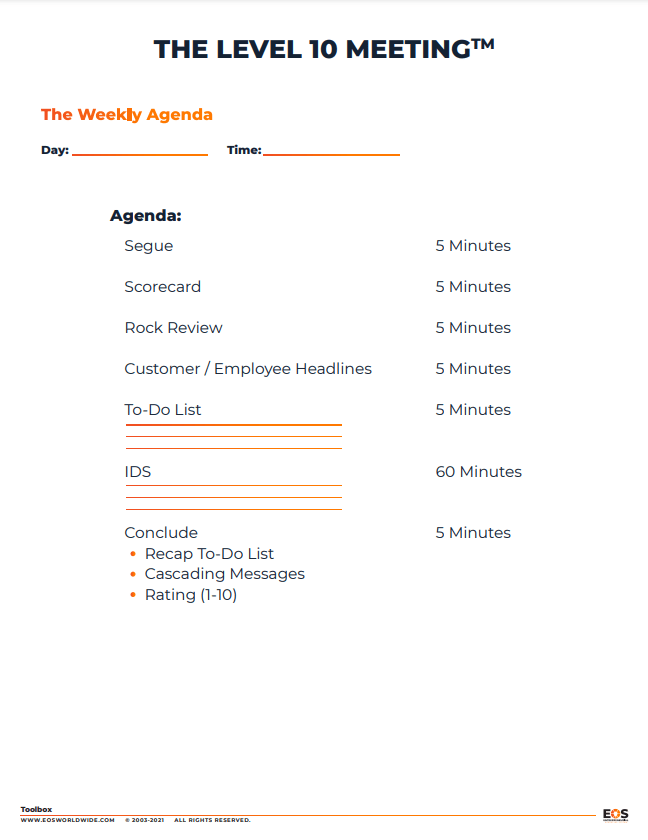
Download the agenda and follow along as you learn how to run an effective Level 10 Meeting.
Move at Your Own Speed, But Keep Moving
After reading Traction, it’s understandable that you’d want to immediately test out every hot tip and EOS Tool that Gino mentions. That energy is useful, but don’t force EOS too fast. Every company moves at its own pace based on the size of the business, the current state of the leadership team, and the level of clarity already in place.
Start with the Five Foundational Tools: Vision/Traction Organizer, Accountability Chart, Scorecard, Rocks, and Level 10 Meeting. Once your leaders have mastered these tools, you can roll them out to the rest of the company.
People need context and a shared language. Employees should understand where the company is going, how Rocks connect to the plan, how the Scorecard helps the business see what is happening, and how Issues get solved. Master the foundation, then bring the rest of the company along with clear communication and repetition.
Remember that steady progress beats rushed activity. The more consistently your leaders use EOS, the easier it becomes for everyone else to understand what is changing and why it matters.
Take Traction from Page to Practice
How will EOS fit your actual business? How will it affect your current structure, solve the problems holding your team back, or change the way you lead?
This is what our free 90-Minute Meeting is for. You’ll meet with a matched EOS Implementer (even if you’re still considering self-implementing), talk through the EOS Model, determine some of the biggest Issues getting in your way, and decide if EOS is right for your team.
With no cost and no obligation, you’ll be more informed about what your business needs next to thrive and see the kind of success you read about in Traction.
Frequently Asked Questions
What do I do after reading Traction?
After reading Traction, bring your leaders together and decide how you will implement EOS. The best next step is a 90-Minute Meeting with an EOS implementer, so your team can get a more complete picture of how the EOS Model, EOS Tools, and EOS Process all come together. From there, your team can decide to work with an EOS Implementer or self-implement EOS.
Can I implement EOS on my own after reading Traction?
Yes, you can self-implement EOS after reading Traction, but your leaders need to agree to follow the EOS Process as purely as possible. You’ll also need a studious internal EOS facilitator who can learn and teach the EOS Tools, host the meetings, keep the team on track, and hold everyone accountable for follow-through.
What is the hardest part of self-implementing EOS?
The hardest part is usually staying consistent and taking action after having productive conversations. Many people are able to understand the EOS Tools, then fail to keep the Meeting Pulse, write SMART Rocks and complete them, solve Issues at the root, or use the Accountability Chart without protecting old titles and habits. There are many common pitfalls along this path, and we find that teams usually turn to an EOS Implementer to course-correct right after experimenting with self-implementation.
Ready to implement EOS?
An EOS Implementer helps your team install the full system and execute it with confidence.